Minerals Hub / Mining & Production / Magnetic separation matches field strength to the mineral
Mining & Production · Ilmenite · 5 min read
Magnetic separation matches field strength to the mineral
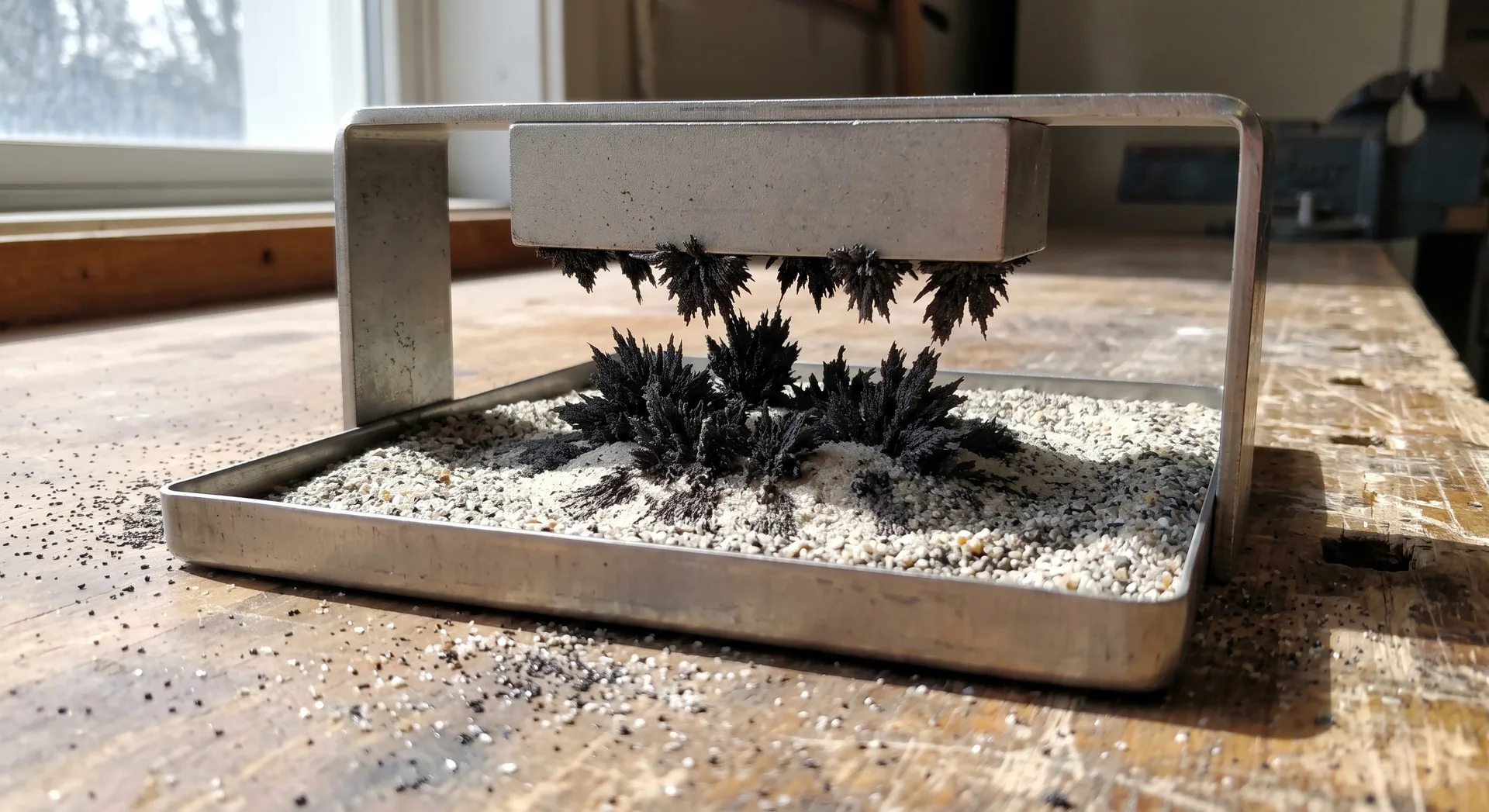
A magnetic circuit can sort a heavy-mineral concentrate by how strongly each grain answers a field, and can take the most responsive first, raising the field for the rest.
Reviewed by Peter Uppal
The short version
A magnetic separator sorts grains by how strongly they respond to a magnetic field, so the field can be raised in stages, taking the most responsive grains first and the weaker ones later. In one 2021 laboratory study of dredged aggregate waste, magnetite and hematite separated at 0.05 tesla (T), ilmenite up to 0.4 T and monazite at 0.9 T. On this publication's reading, where a mineral reports depends on more than its name: a 1993 poster on a Malawi beach sand reported monazite concentrating in the non-magnetic products of that study's circuit.
What the field is asking each grain
A trade explainer in CIM Magazine defines magnetic susceptibility as a measure of "how susceptible a mineral is to a magnetic field", and adds that the higher the susceptibility, the stronger the attraction. The sign matters as well as the size: a negative susceptibility means the mineral is repelled.
A 2016 McGill doctoral thesis on rare-earth beneficiation traces the response to unpaired electrons, which induce magnetic dipoles in the material. It notes that mineral processing recognises three behaviours: ferromagnetic and paramagnetic particles are attracted along the field lines, and diamagnetic particles are repelled.
Jordens's thesis also states the condition every separator has to meet. Recovery in a magnetic separator depends on the applied field strength, the field gradient and the particles' magnetic susceptibility, the gradient being how sharply the field changes over distance, and a strong field with no gradient exerts no magnetic force. A field figure on its own is therefore only part of what decides what a machine will pull.
Low field first
Strongly magnetic grains can be taken at low field. According to Jordens, who takes the figure from Murariu and Svoboda (2003), minerals that respond strongly at low field, such as magnetite, may be concentrated with a low-intensity field, below 0.3 T. One of the main machines for this is the wet drum separator, with fixed permanent magnets inside a rotating shell.
The staging is clearest in a laboratory. A 2021 study in Minerals worked on dredged fine-aggregate waste from Pyeongtaek in South Korea, not on a placer sand, using a laboratory-scale cross-belt separator with the field raised from 0.05 T to 1.2 T. In that laboratory study, magnetite and hematite were separated first, at 0.05 T; ilmenite at 0.4 T; then monazite at 0.9 T. Moscoso-Pinto and Kim record that ilmenite appeared from 0.05 T until 0.4 T, "as it is a paramagnetic mineral". Their separator could be adjusted through the electromagnet's voltage or its height above the belt, and the study used voltage.
A 2004 study of Sri Lankan beach sand began lower still. In that study, a 0.04 T hand magnet showed that less than 1% by mass of highly magnetic minerals is present in the deposit, and magnetite and ilmenite were found in that magnetic fraction.
In a staged run: first the grains that cannot refuse a weak field, then the ones that need a strong one, then whatever refuses every field.
Turning the field up
Premaratne and Rowson then ran samples on an isodynamic separator at 0.1, 0.3 and 0.5 T, and only rutile and zircon were confirmed in the 0.5 T non-magnetic tailing. On a disc separator the authors judged 0.5 T the optimum, since higher fields up to 0.8 T changed the results only slightly.
At plant scale, different machines take different parts of the job. Mineral Technologies, an equipment maker, offers low and medium intensity wet and dry drum separators for the more strongly magnetic minerals, rare-earth permanent-magnet separators for dry separation of paramagnetic minerals, and wet high-intensity magnetic separators (WHIMS) where a higher magnetic field gradient is required to remove weakly magnetic particles from non-magnetic concentrates.
Kenmare Resources describes heavy-mineral concentrate at its Moma mine being fed to a WHIMS plant "to separate magnetic from non-magnetic fractions", with the mineral separation plant using magnetic, gravity and electrostatic circuits to make individual products. A 2001 conference paper reported that powerful wet rare-earth drum separators had become a possible option for wet ilmenite preconcentration.
Later stages, through to final cleaning
Authors from Mineral Technologies, writing in 2024, say heavy-mineral-sands beneficiation is "often completed by a combination of size classification, gravity concentration" and upgrading by wet or dry magnetic separation, as well as electrostatics. At Sri Lanka's Pulmoddai plant, as Premaratne and Rowson describe it in 2004, ilmenite is recovered by wet magnetic separation.
As of 2001, a conference paper reported that rare-earth roll and drum separators were used from ilmenite concentration to cleaning high-purity zircon products. The CIM explainer adds that diamagnetic minerals report to the non-magnetic fraction of a dry magnetic separator.
The Kerala Minerals and Metals Ltd, in India, splits its conducting fraction into magnetic (ilmenite) and non-magnetic (rutile-rich) fractions with magnetic separators, and then cleans the rutile-rich fraction with further high-tension (electrostatic) and induced-roll magnetic separators.
Where the minerals land, and where they do not
Mineral Technologies lists, for mineral-sands suites, recovery of ilmenite, garnet, chromite and monazite into the magnetics of its separators, and of rutile, leucoxene and zircon into the non-magnetics. Premaratne and Rowson, citing Stradling (1991), name leucoxene among the titanium minerals that some plants recover by dry magnetic separation, so the two sources place leucoxene differently.
Monazite is less settled. In a general passage of a 2024 study of the Bramhagiri placer in Odisha, India, the authors write that monazite is weakly magnetic compared to zircon, so that the two can be separated using magnetic separation. In their own tests, magnetic separation alone did not produce the desired grade of monazite. A 1993 British Geological Survey poster on a Malawi beach sand reported the opposite placement: monazite, "which is moderately magnetic, was found to concentrate in the non-magnetic products". The Malawi poster found ilmenite highly magnetic and conductive.
Ilmenite's category also varies between sources. The CIM explainer lists it under ferrimagnetism, with magnetite; the 2021 Korean study calls it a paramagnetic mineral. On this publication's reading, that is the practical lesson of a staged circuit: a mineral reports wherever its grains, in that feed, cross the threshold of that machine.
What Osmond has reported
Osmond reported in its 30 September 2026 resource release that "Preliminary laboratory testwork has included crushing, grinding, screening, desliming, gravity concentration, wet high-intensity magnetic separation (WHIMS), electrostatic separation and flotation." The release also states that "Metallurgical work is preliminary and does not provide overall plant recoveries."
Related
- Processing Technology
- Ore Processing
- Metallurgy
- Refining
- Exploration
Sources
- PRIMARYDanoczi, J., 'Magnetic separation – an attractive sorting option', CIM Magazine, 2 April 2020. Trade-magazine explainer: definition of magnetic susceptibility; negative susceptibility and repulsion; diamagnetic minerals reporting to the non-magnetic fraction of a dry separator; list of ferrimagnetic minerals.
- PRIMARYJordens, A., The beneficiation of rare earth element-bearing minerals, PhD thesis, McGill University, April 2016. Chapter 2, §2.3.1, printed pp. 15–16: unpaired electrons; three behaviours in mineral-processing terminology; recovery dependent on field strength, field gradient and susceptibility (Equation 2.3, after Oberteuffer, 1974). §2.3.4, printed pp. 21–22: the wet drum separator.
- SECONDARYJordens, A., PhD thesis, McGill University, April 2016, §2.3.4, printed p. 21, citing Murariu and Svoboda (2003): minerals with relatively high susceptibility at low field may be concentrated using a low-intensity (< 0.3 T) field. A thesis reporting another work's figure, so tagged SECONDARY.
- PRIMARYMoscoso-Pinto, F. and Kim, H.-S., 'Concentration and Recovery of Valuable Heavy Minerals from Dredged Fine Aggregate Waste', Minerals 11(1), 49, 2021. §2.4: laboratory-scale cross-belt magnetic separator (Eriez HCB 7-11-2), field raised from 0.05 T to 1.2 T, adjustable by voltage or magnet height; magnetite and hematite at 0.05 T, ilmenite at 0.4 T, monazite at 0.9 T. §3.3: ilmenite from 0.05 T until 0.4 T, described as paramagnetic. Feed: dredged fine-aggregate waste, Pyeongtaek, South Korea.
- PRIMARYPremaratne, W.A.P.J. and Rowson, N.A., 'Recovery of titanium from beach sand by physical separation', European Journal of Mineral Processing and Environmental Protection 4(3), 183–193, 2004 (copy hosted at 911metallurgist.com). §3.1, p. 186: 0.04 T hand magnet, less than 1% by mass highly magnetic minerals, magnetite and ilmenite in the magnetic fraction. pp. 184, 187–188: Cook isodynamic separator at 0.1, 0.3 and 0.5 T; only rutile and zircon confirmed in the 0.5 T non-magnetic tailing; 0.5 T judged the optimum on a disc separator.
- SECONDARYPremaratne, W.A.P.J. and Rowson, N.A., 2004, Introduction, p. 183: wet magnetic recovery of ilmenite at the Pulmoddai mineral separation plant, Sri Lanka (citing Lanka Mineral Sand Ltd, 1999); dry magnetic separation in some plant operations, particularly for ilmenite and leucoxene (citing Stradling, 1991). Authors describing plant practice from other works, so tagged SECONDARY.
- PRIMARYMineral Technologies (CPG Resources), 'Leaders in Mineral Separation: Magnetic Separators', product brochure, undated. Equipment maker's own material: low- and medium-intensity wet and dry drum separators; rare-earth permanent-magnet separators for dry separation of paramagnetic minerals; wet high-intensity magnetic separators (WHIMS); minerals recovered into magnetics and non-magnetics in mineral-sands applications.
- PRIMARY'The Many Uses of Rare-Earth Magnetic Separators for Heavy Mineral Sands Processing', International Heavy Minerals Conference, AusIMM, 2001 (authors not shown), abstract. Rare-earth roll and drum separators used from ilmenite concentration to cleaning high-purity zircon; wet rare-earth drum separators as a possible option for wet ilmenite preconcentration.
- PRIMARYMitchell, C.J. and Yusof, M.A., 'Beneficiation and appraisal of a beach placer sand deposit from Malawi', poster, Rare Earth Minerals: Chemistry, Origin and Ore Deposits, London, 1–2 April 1993 (British Geological Survey; NORA eprint 8941). Monazite, moderately magnetic, concentrating in the non-magnetic products; ilmenite highly magnetic and conductive.
- PRIMARYSingh, D. and others, 'Development of Process Flow Sheet for Recovering Strategic Mineral Monazite from a Lean-Grade Bramhagiri Coastal Placer Deposit, Odisha, India', Minerals 14(2), 139, 2024. §3.1, p. 5: the authors' general statement that monazite is weakly magnetic compared to zircon. §3.4, p. 14: magnetic separation alone not producing the desired grade of monazite.
- PRIMARYKenmare Resources plc, 'Moma's operating process', company web page (published 24 September 2024, modified 15 May 2026). Producer's own description: heavy-mineral concentrate stockpiled at the mineral separation plant and fed to the WHIMS plant; magnetic, gravity and electrostatic circuits in the MSP.
- PRIMARYThe Kerala Minerals and Metals Ltd (KMML), 'Manufacturing Facility: Mineral Separation Unit', company web page, undated. Producer's own description: dry mill splitting the conducting fraction into magnetic (ilmenite) and non-magnetic (rutile-rich) fractions; rutile recovery plant using high-tension electrostatic and induced-roll magnetic separators.
- PRIMARYRaffaillac, E. and MacHunter, R. (Mineral Technologies), 'Flowsheet Development of Two Distinct Rare Earth Minerals Bearing Heavy Mineral Sand Ores', XXXI IMPC 2024 Proceedings, SME, p. 1208. Authors from an equipment maker: beneficiation often combining size classification, gravity concentration, wet or dry magnetic separation and electrostatics.
- PRIMARYOsmond Resources (ASX: OSM), ASX release, 30 September 2026, 'Maiden Mineral Resource Estimate demonstrates substantial grade and scale potential at Orión'. p. 4: the methods included in preliminary laboratory testwork. p. 24: 'Metallurgical work is preliminary and does not provide overall plant recoveries.'
- ANALYSISANALYSIS: the reading that a magnetic circuit sorts by threshold, so that where a mineral reports depends on the field, the machine and the particular feed rather than on the mineral's name alone. This publication's framing.Non-public document · no public URL