Minerals Hub / Geography & Supply Chains / Japan's approach to rare-earth security since 2010
Geography & Supply Chains · 6 min read
Japan's approach to rare-earth security since 2010
Japan's official record and Lynas's announcements show one agency empowered to invest, guarantee and stockpile, an offtake arrangement with Lynas through JARE, and programmes to use less; this piece reads each from the documents.
Reviewed by Osmond Hub editors
The short version
The Japan Organization for Metals and Energy Security (JOGMEC), Japan's state metals agency, holds statutory powers to make equity investments and guarantee debts for metal-mineral projects, and to stockpile metal mineral products, and in December 2010 the Cabinet said it would support Japanese companies' mine acquisitions through it. Under a March 2026 agreement announced by Lynas, JARE, a company Lynas describes as established by JOGMEC and Sojitz, would commit to buy 5,000 tonnes a year of NdPr for Japanese industry. Japan Customs data for 2025 record 8,248,882 kg of imports under HS 2805.30, the code for rare-earth metals, scandium and yttrium, of which 5,415,988 kg came from China.
The 2010 dispute, as the record has it
Revisiting the China–Japan rare-earths dispute of 2010, Evenett and Fritz note in a 2023 column that China "never stated publicly that it had cut exports of Rare Earths to Japan", while adding that "We do not conclude that there were no episodes of disruption to exports". Using UN Comtrade data, Evenett and Fritz found that "it is Australia— not Japan—that experienced many one monthly falls" [sic] in rare-earth shipments from China.
What the Cabinet said it would do
The 14 December 2010 answer stated that the government intends to support accelerated practical use of technologies for substituting and reducing the use of rare earths and similar materials. The answer also stated support for developing technology and installing equipment to dismantle and extract rare earths from end-of-life products. And the 14 December 2010 answer said the government would support Japanese companies' acquisitions of mines through JOGMEC and strengthen ties with resource countries through technical cooperation, with a total of ¥46 billion budgeted for JOGMEC's equity investment in rare-earth asset acquisitions, interest on its private borrowings for that purpose, additions to its debt-guarantee credit fund and cooperation projects with resource countries.
"...a total of 46 billion yen has been budgeted." (Cabinet written answer, 14 December 2010, on four items led by JOGMEC's equity investment in rare-earth asset acquisitions, in this publication's translation)
The agency and its powers
The Act authorises JOGMEC to make equity investments to fund exploration and mining of metal minerals overseas and in waters around Japan, and beneficiation and smelting overseas and in Japan, with funding in waters around Japan limited to acquiring rights and starting operations. The Act also authorises JOGMEC to guarantee debts for overseas metal mining and for metal-mineral beneficiation and smelting overseas and in Japan, and to stockpile metal mineral products.
Those powers grew in steps. On 1 July 2010 JOGMEC's equity-investment function was expanded to cover asset acquisitions (mine acquisitions) of rare metals and other metal mineral products, a change dated before the Cabinet's emergency package of 8 October 2010. A law promulgated on 12 June 2020 added equity investment in metal-mineral development projects and equity and debt guarantees for beneficiation and smelting projects to JOGMEC's functions.
The stockpile
JOGMEC describes its stockpile as a safeguard against short-term supply interruptions of rare metals, and states that stockpiled rare metals will be released in response to an interruption of supply from overseas or a shortage in domestic supply. In July 2020 METI's Agency for Natural Resources and Energy said Japan stockpiles selected metals from among what it called 34 rare metals, with a combined public and private target of 60 days of standard domestic consumption (30 days for some metals), a target set in 1986. In July 2020 METI's resource agency also said that the stockpile would be reviewed upward to match current risk, with targets set flexibly by metal and, from then on, for the national stockpile alone.
Lynas, through JARE
Lynas describes JARE (Japan Australia Rare Earths B.V.) as a special purpose company established by Japan Oil, Gas and Metals National Corporation (JOGMEC) and Sojitz Corporation. As at 5 September 2022, Lynas reported that it and JARE were parties to a long-term senior loan facility with a principal balance of US$141 million, at 2.5% a year, maturing 30 June 2030. Under the September 2022 terms, in the event of competing demands, the Japanese market has priority of supply of NdPr from the Malaysian plant of up to 7,200 tonnes a year, until 2038, subject to what Lynas calls the "Availability Agreement" and with, in Lynas's words, "no opportunity loss". In March 2023 JARE agreed to invest A$200 million in Lynas through a subscription for ordinary shares, Lynas announced.
On 10 March 2026 Lynas announced that JARE would commit to buy 5,000 tonnes of NdPr a year for Japanese industry, with a contractual floor price of US$110/kg NdPr for sales to Japanese industry. Under the agreement Lynas announced on 10 March 2026, where Lynas's achieved price is above US$150/kg NdPr, 30% of the upside goes to JARE, capped at US$10 million per calendar year. The 2026 agreement, as Lynas announced it, makes 75% of all heavy rare earth oxides produced by Lynas (heavy rare earths as Lynas uses the term) available to Japanese industry, with a firm commitment from JARE to purchase the equivalent of 50% of them, at prices and terms that represent, in Lynas's words, "no opportunity loss" to Lynas.
Using less
Before 2010, a METI/NEDO "Rare Metal Substitute Materials Development Project" set a target to establish technology able to cut dysprosium use per unit in rare-earth magnets by 30% or more by FY2011, with an interim 20% target for FY2009. NEDO's FY2013 implementation policy planned about ¥100 million that year, at a subsidy rate of up to two-thirds, for FY2013–2014 work on recycling rare-earth magnets from used motors, citing stable supply of neodymium and dysprosium.
What the customs data record
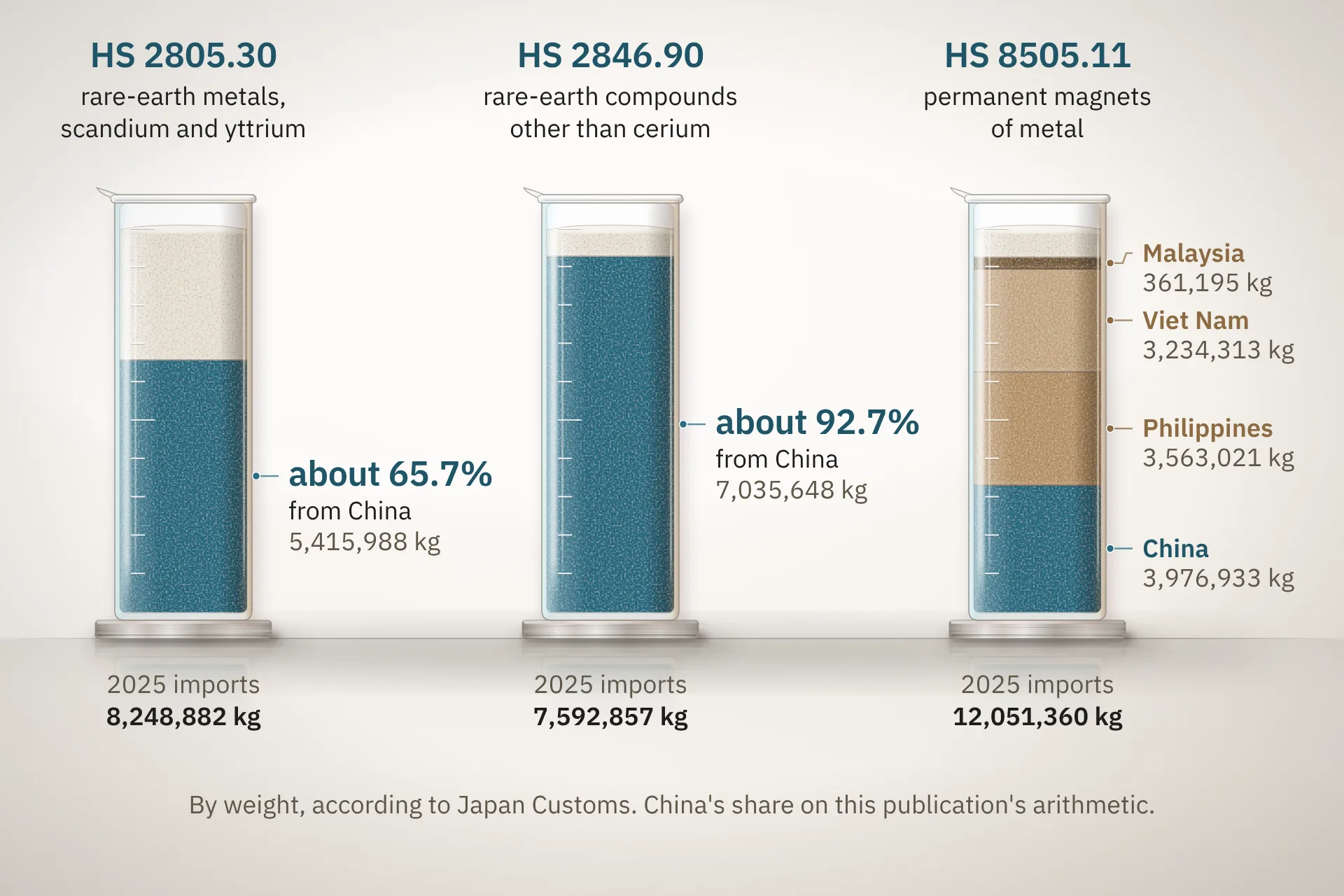
In 2025 Japan's imports under HS 2805.30 (rare-earth metals, scandium and yttrium) totalled 8,248,882 kg according to Japan Customs, of which 5,415,988 kg came from China. In 2025 Japan's imports under HS 2846.90 (rare-earth compounds other than cerium) totalled 7,592,857 kg according to Japan Customs, of which 7,035,648 kg came from China. On this publication's arithmetic, China's share by weight was about 65.7% of Japan's 2025 HS 2805.30 imports and about 92.7% of its 2025 HS 2846.90 imports. Japan's 2025 imports of permanent magnets of metal (HS 8505.11) totalled 12,051,360 kg, of which 3,976,933 kg came from China, 3,563,021 kg from the Philippines, 3,234,313 kg from Viet Nam and 361,195 kg from Malaysia.
As of 26 October 2026, Japan Customs data for January to August 2026, provisional, show monthly imports from China under HS 2805.30 of between 270,200 kg (January) and 651,130 kg (February).
Japan's 2026 tariff schedule groups yttrium with rare-earth metals and scandium under 2805.30-000, and splits HS 2846.90 into yttrium oxide (2846.90-210), lanthanum oxide (-220) and other (-290).
How the parts fit
On this publication's reading, Japan's approach since 2010 combines an agency with statutory powers to invest, guarantee debts and stockpile, an offtake and financing arrangement with Lynas through JARE, and programmes to use less of the rare earths it imports. The agreement Lynas announced with JARE on 10 March 2026 runs until 2038.
Related
- Strategic Stockpiles — how stockpile targets are set and held
- International Partnerships — offtake and financing ties like JARE's with Lynas
- Critical Mineral Strategies — other countries' plans set beside Japan's
- Countries — Japan among the importing countries
- Global Trade — where Japan's rare-earth imports come from
Sources
- SECONDARYEvenett, S. and Fritz, J., 'Revisiting the China–Japan Rare Earths dispute of 2010', CEPR VoxEU column, 19 July 2023. An economists' column, not peer-reviewed, so tagged SECONDARY.
- PRIMARYHouse of Councillors, Cabinet written answer No. 214 (内閣参質一七六第二一四号), '資源の安全保障に関する質問に対する答弁書', 14 December 2010, 176th Diet. PDF pp. 1–2: measures tied to the emergency economic package of 8 October 2010; substitution and reduced use; recovery from waste products; support through JOGMEC; ¥46 billion budgeted.
- PRIMARYJOGMEC, 沿革 (history) web page, Japanese, captured 26 October 2026. PDF pp. 1–3: establishment on 29 February 2004; expansion of equity investment on 1 July 2010; functions added under a law promulgated on 12 June 2020.
- PRIMARYAct on the Japan Organization for Metals and Energy Security (独立行政法人エネルギー・金属鉱物資源機構法), Act No. 94 of 2002, promulgated 26 July 2002; current text via the e-Gov API, 26 October 2026. Art. 11(1)(i) equity investment; Art. 11(1)(iii) debt guarantees; Art. 11(1)(xiii) stockpiling of metal mineral products.
- PRIMARYAgency for Natural Resources and Energy (METI), 'Japan's new international resource strategy to secure rare metals', 31 July 2020 (Japanese; English provisional translation, 30 September 2020, at https://www.enecho.meti.go.jp/en/category/special/article/detail_158.html). Japanese PDF p. 6: stockpile of selected rare metals, 60-day target (30 days for some metals) set in 1986, and its review.
- PRIMARYJOGMEC, 'Stockpiling: Metals' web page (English; undated; web read). Introductory paragraph: stockpile as a safeguard against short-term supply interruptions; release on interruption of overseas supply or domestic shortage.
- PRIMARYLynas Rare Earths Ltd, ASX announcement on amended JARE agreements, 5 September 2022. PDF pp. 1, 3–5: JARE described as established by Japan Oil, Gas and Metals National Corporation and Sojitz; senior loan facility as at September 2022; share subscription for Mt Weld exploration; priority of supply to the Japanese market.
- PRIMARYLynas Rare Earths Ltd, ASX announcement on JARE funding, 7 March 2023 (ASX document 02640930, Lynas investor-relations host copy). PDF p. 1: JARE subscription for ordinary shares.
- PRIMARYLynas Rare Earths Ltd, ASX announcement 'Enhanced JARE Agreement for Japanese Industry', 10 March 2026. PDF p. 1: NdPr purchase commitment and contractual floor price; upside sharing and cap; heavy rare earth oxide availability; term to 2038; CEO statement.
- PRIMARYNEDO, 「希少金属代替材料開発プロジェクト」 平成20年度実施方針 (FY2008 implementation policy, Rare Metal Substitute Materials Development Project). PDF pp. 1, 3: dysprosium-reduction targets for FY2009 and FY2011.
- PRIMARYNEDO, 「使用済モーターからの高性能レアアース磁石リサイクル技術開発」 平成25年度実施方針 (FY2013 implementation policy), February 2013. PDF pp. 1–3: planned scale and subsidy rate for magnet recycling from used motors, FY2013–2014.
- PRIMARYJapan Customs (Ministry of Finance), Trade Statistics, 'Commodity by Country', imports, 2025 (January–December), HS 2805.30, 2846.10, 2846.90 and 8505.11 (national nine-digit codes), quantity in kg and value in ¥ thousand. CSV export from the site's query tool, 26 October 2026; the query has no static URL.
- PRIMARYJapan Customs (Ministry of Finance), Trade Statistics, imports from China, monthly, January–August 2026 (provisional), HS 2805.30 and 2846.90, quantity in kg and value in ¥ thousand. CSV exports from the site's query tool, 26 October 2026; the queries have no static URL.
- PRIMARYJapan Customs, 'Japan's Tariff Schedule as of July 9, 2026', Chapter 28: 2805.30-000; 2846.90-210 (yttrium oxide), -220 (lanthanum oxide), -290 (other).
- ANALYSISANALYSIS: the reading of Japan's measures as one approach combining an agency's finance and stockpile powers, an offtake arrangement and demand reduction; and China's shares by weight of Japan's 2025 imports under HS 2805.30 (5,415,988 / 8,248,882 kg, about 65.7%) and HS 2846.90 (7,035,648 / 7,592,857 kg, about 92.7%), computed by this publication from the Japan Customs figures.Non-public document · no public URL