Minerals Hub / Companies & Organisations / Lynas, from the Mount Weld mine to Malaysia and Kalgoorlie
Companies & Organisations · Monazite · 6 min read
Lynas, from the Mount Weld mine to Malaysia and Kalgoorlie
How Lynas's chain from a Western Australian mine to processing plants in Kalgoorlie and Malaysia was financed and licensed, and what it sells, as its filings and regulators record it.
Reviewed by Peter Uppal
The short version
Lynas mines a rare earths concentrate at Mount Weld in Western Australia and, according to its 2026 annual report, in the year to 30 June 2026 cracked and leached it both at Kalgoorlie and at its plant at Gebeng, Malaysia, where it also separates and finishes products. Lynas reported 13,089 t of ready-for-sale rare earth oxide produced in the year to 30 June 2026, including 7,260 t of NdPr. On 2 March 2026 Lynas announced that its Malaysian operating licence had been renewed for ten years from 3 March 2026, with the formal licence then still to be issued.
One mine, two processing countries
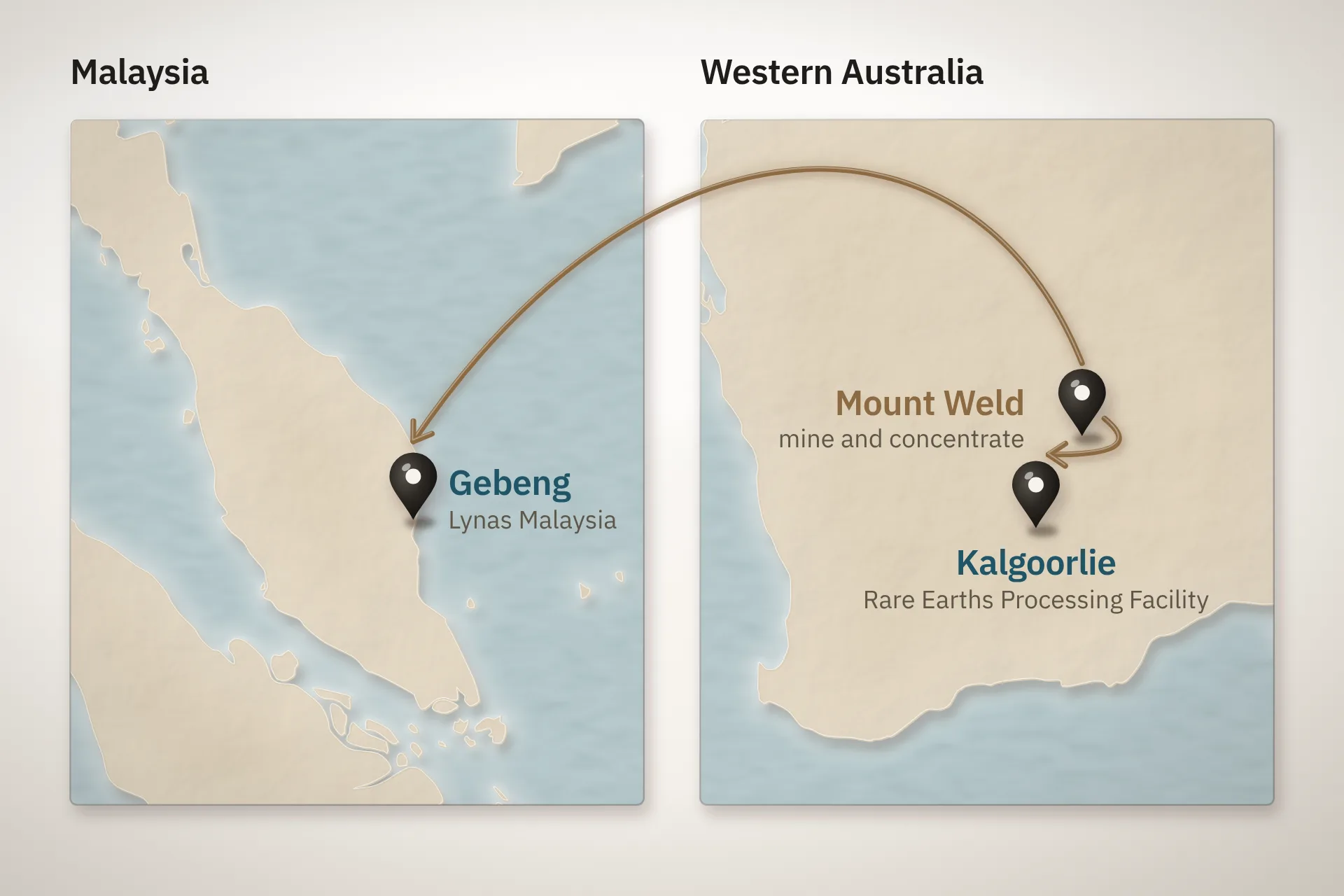
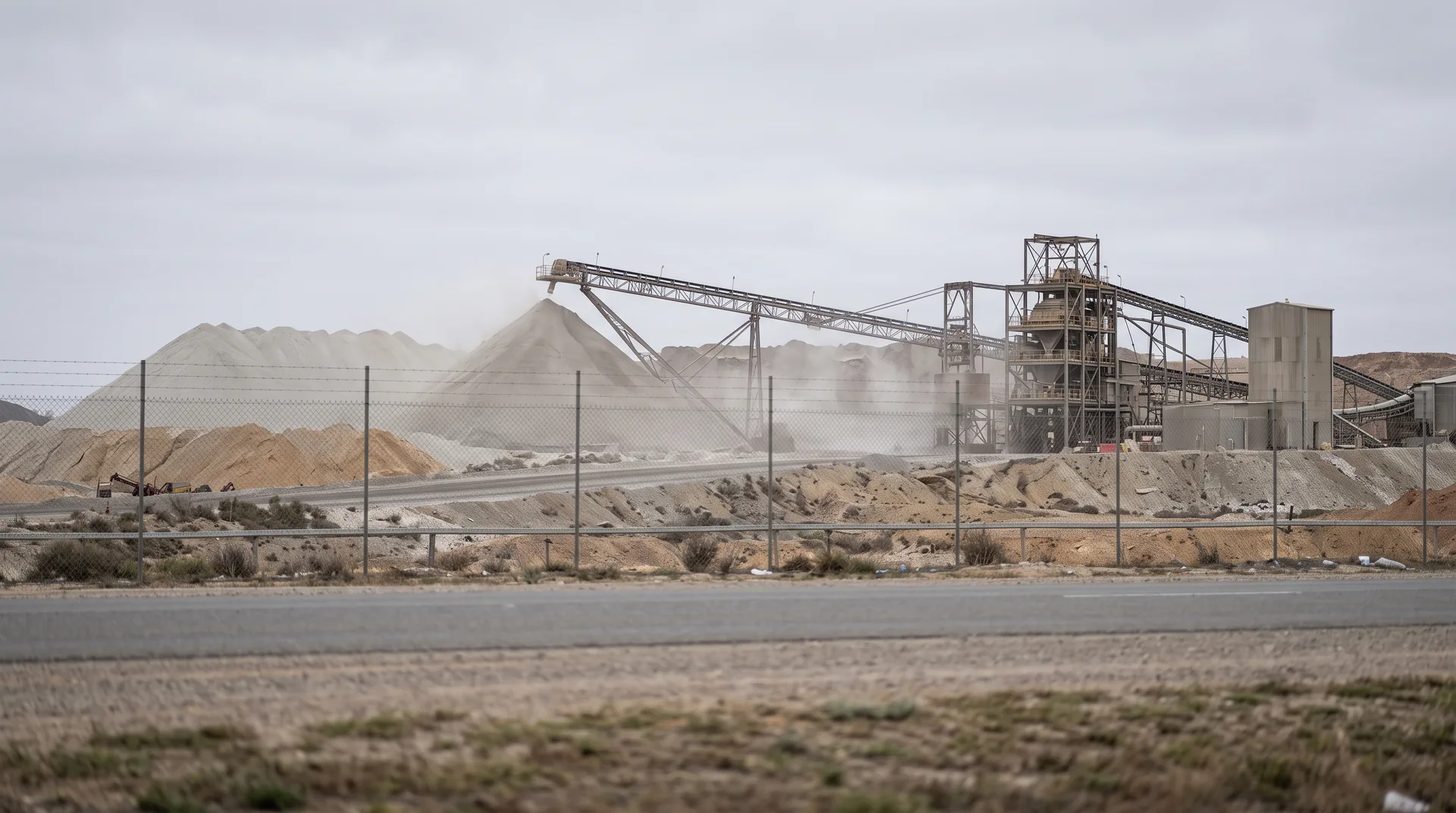
Lynas mines and produces a rare earths concentrate at Mount Weld (Mt Weld) in Western Australia, and its 2026 annual report says Mt Weld feedstock supplies both Lynas Malaysia and the Kalgoorlie facility.
In FY26 (Lynas's financial year ends 30 June), by the company's account, it cracked and leached concentrate both at its Kalgoorlie Rare Earths Processing Facility, which produces a mixed rare earth carbonate (MREC) and was still ramping up, and at its Malaysian plant in Gebeng. Cracking and leaching are the first chemical steps, which break down the concentrate and take its rare earths into solution. Lynas's 2026 annual report describes the Gebeng plant as carrying out cracking and leaching, solvent-extraction separation and product finishing.
Mt Weld feedstock supplies both Lynas Malaysia and the Kalgoorlie facility, Lynas's 2026 annual report says.
Licensed in Malaysia, on conditions
On 15 February 2023 Malaysia's Ministry of Science, Technology and Innovation (MOSTI) announced that the Atomic Energy Licensing Board (AELB) had renewed Lynas's licence for three years, from 3 March 2023 to 2 March 2026. MOSTI's 15 February 2023 statement said AELB had rejected Lynas's application to remove four licence conditions, including the one on importing lanthanide concentrates from Australia. In that statement the Minister said no cracking and leaching would be carried out at Gebeng after July 2023.
In October 2023, The Star reported, the science minister announced revised terms allowing Lynas Malaysia to import lanthanide concentrate until its licence expired, subject to a condition on the radioactivity of its water-leach purification (WLP) residue.
On 2 March 2026 Lynas announced that the regulator, which it names the Department of Atomic Energy, had renewed Lynas Malaysia's operating licence for ten years from 3 March 2026, with the formal licence then still to be issued. Berita RTM gave the end date as 2 March 2036, with the renewal made by MOSTI through the Atomic Energy Department, its own name for the regulator. Malaysia's science minister also told a press conference that day that the renewal kept a requirement for Lynas to put 1% of annual gross sales into R&D, as reported by RTM on 2 March 2026.
Lynas describes one condition of the 2026 licence in its annual report: it must implement an alternative cracking process so the plant no longer produces WLP residue above 1 Bq/g (becquerels per gram) after 2 March 2031, with modification to start by March 2028, and the company says the licence may be revoked for non-compliance.
Lynas's annual report of 26 August 2026 records that it cracked and leached concentrate at its Malaysian plant in Gebeng in FY26. The documents cited here do not say whether the 2023 position was later revised.
Japanese money, renegotiated
Lynas describes its partnership with Japan Australia Rare Earths B.V. (JARE) as having served both organisations "over the past 15 years"; JARE is a special purpose company established by JOGMEC and Sojitz Corporation. A September 2022 Lynas announcement refers back to an "Availability Agreement announced 20 March 2011" with JARE, concerning supply rights.
According to Lynas's 5 September 2022 announcement, the senior loan facility then had a principal balance of US$141 million at 2.5% a year interest, maturing 30 June 2030; JARE would provide US$9 million through a share subscription to fund exploration at Mt Weld; and priority supply rights to Japan to 2038 were unchanged. In an announcement dated 7 March 2023, JARE agreed to subscribe A$200 million of Lynas shares, which Lynas said may fund projects to increase light and heavy rare earth production, and to forgo US$11.5 million of deferred 2016 interest under the existing loan.
At 30 June 2026 the JARE loan was US$90m principal (face value A$130.8m), with a carrying amount of A$119.7m (FY25 A$151.3m), repayable between 31 December 2026 and 30 June 2030. Lynas announced that a further agreement of 10 March 2026 runs to 2038, with a firm JARE commitment of 5,000 t a year of NdPr, a floor of US$110/kg NdPr for sales to Japanese industry, and JARE buying the equivalent of 50% of Lynas's heavy rare earth oxides at prices and terms that, in Lynas's words, "represent no opportunity loss to Lynas".
What leaves the plants
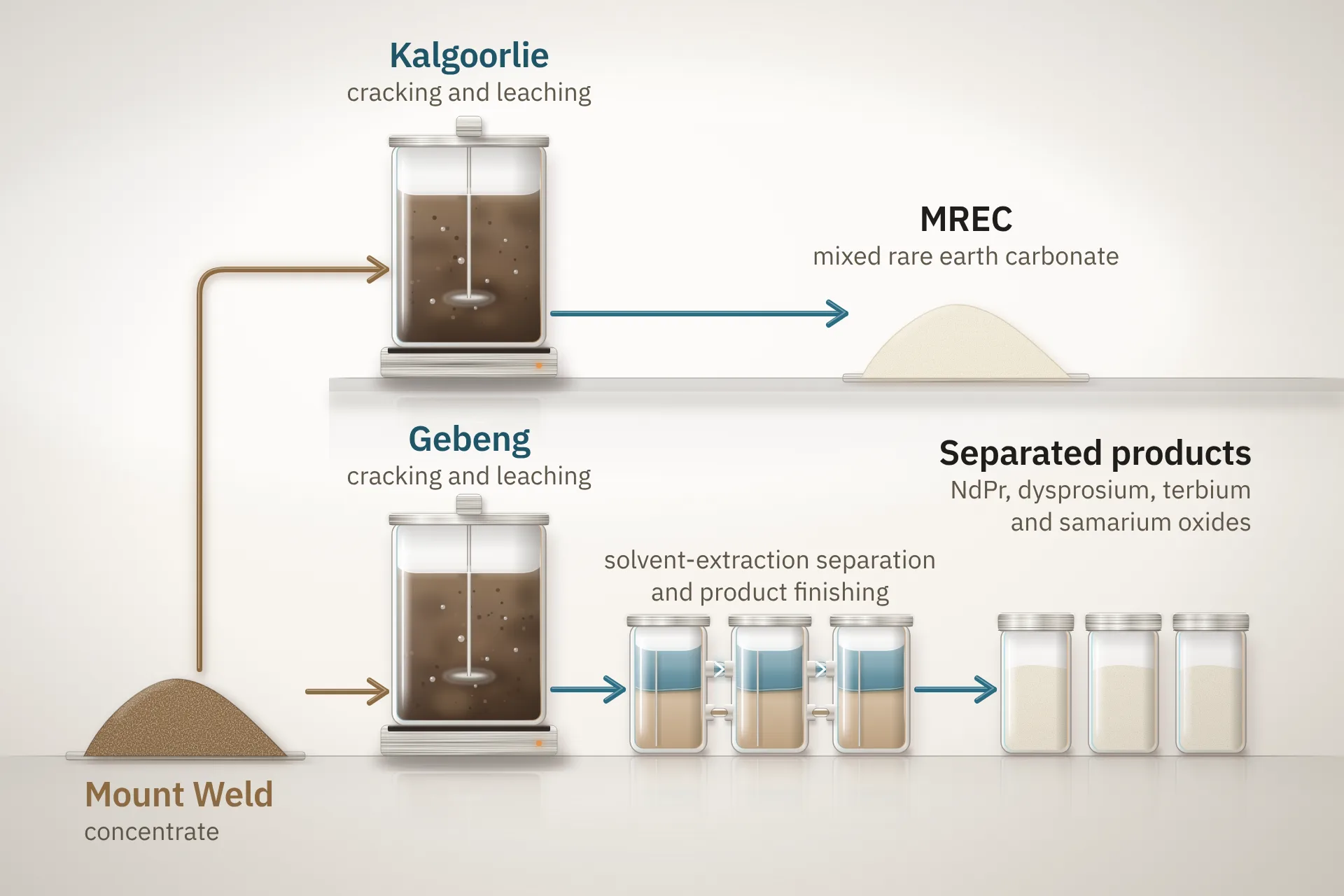
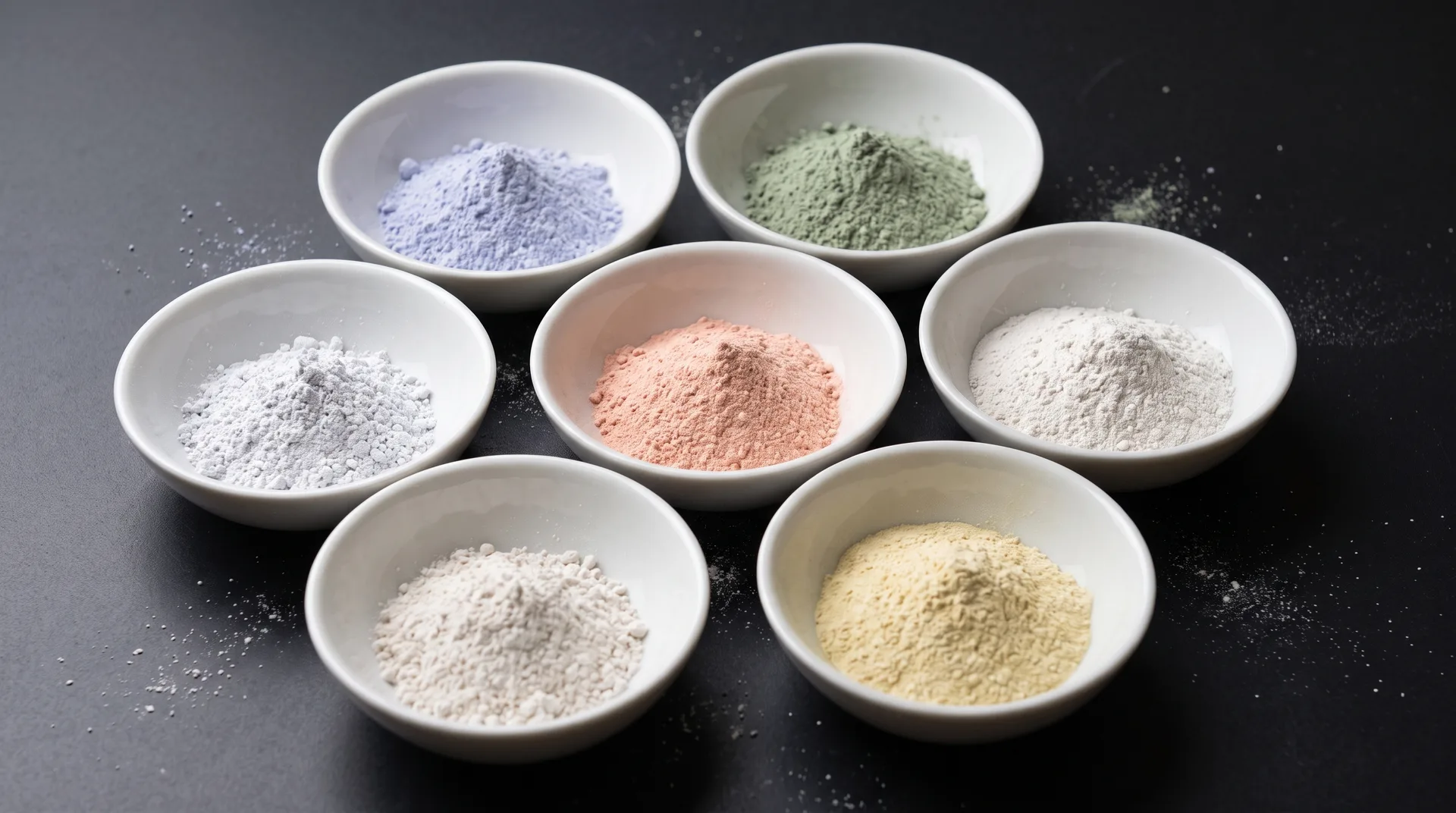
As of its 2026 annual report, Lynas's separated products include NdPr and the heavy rare earth oxides dysprosium and terbium, as well as samarium, which Lynas classes as a heavy rare earth oxide; gadolinium is expected in early FY28 and yttrium in early CY28, and lutetium is planned. As of the annual report of 26 August 2026, samarium oxide was first produced in March 2026, with initial orders expected to be fulfilled in Q1 FY27.
In FY26 Lynas produced 13,089 t of ready-for-sale REO including 7,260 t of NdPr, and sales were 12,122 t REO including 7,337 t NdPr.
As of the June 2026 quarter, Lynas put the estimated cost of its Malaysian heavy rare earths expansion at about A$294m including contingency, up from about A$180m, with first gadolinium expected in early FY28.
The American thread
As of its June 2026 quarterly report, Lynas has had a contract with the US Government relating to US rare earths supply chain resilience since 2021. Its 2026 annual report says the planned Texas heavy rare earth facility will no longer proceed; the letter of intent of 16 March 2026 says the original agreement was modified because of significant uncertainty over whether the Seadrift, Texas facility would be built.
The 16 March 2026 letter, signed with the US Department of War, as Lynas names it, is a binding letter of intent for about US$96m of light and heavy rare earth oxides over four years, with an NdPr oxide floor price of US$110/kg. As of the annual report of 26 August 2026, Lynas still described it as a binding Letter of Intent, with further heavy rare earth supply under discussion and a definitive agreement still pending at that date.
A proposed acquisition
On 1 October 2026 Lynas signed a binding Scheme Implementation Deed to acquire Meteoric Resources, owner of the Caldeira ionic clay rare earth project in Minas Gerais, Brazil, for 0.0207 new Lynas shares per Meteoric share, with implementation expected, on an indicative timetable, by March 2027, subject to conditions including shareholder, Court and Brazilian regulatory approvals. As of 26 October 2026 the acquisition was proposed and pending.
Related
- Processing Centres — Lynas's Kalgoorlie and Gebeng plants among the world's processing sites
- Countries — Australia and Malaysia as processing countries
- Government Agencies — the Malaysian regulator and the Japanese and US bodies named here
- Regulation — how licence conditions shape a processing plant
- Supply Chain Risk — what one large producer outside China means for supply
Sources
- PRIMARYLynas Rare Earths Ltd, 2026 Annual Report including Appendix 4E, year ended 30 June 2026 (directors' declaration dated 26 August 2026). p. 3 and p. 29: Mt Weld, Kalgoorlie and Lynas Malaysia operations; p. 16 and p. 25: 2026 licence conditions; note C.3: JARE borrowings; production and product range for FY26; Texas facility and US DoW letter of intent status.
- PRIMARYLynas Rare Earths Ltd, 'Lynas Rare Earths financial results for the year ending 30 June 2026', ASX release, 26 August 2026. FY26 sales.
- PRIMARYLynas Rare Earths Ltd, 'Quarterly report for the period ended 30 June 2026', ASX release, 22 July 2026 (unaudited). Heavy rare earths expansion cost; US Government contract.
- PRIMARYMinistry of Science, Technology and Innovation (MOSTI), Malaysia, press statement PS 230215, 'Lynas License Renewal – No More Radioactive Waste Can Be Produced by Lynas in Malaysia', 15 February 2023 (English version). Licence renewal for three years; rejection of four licence-condition removals; the Minister's statement on cracking and leaching at Gebeng.
- SECONDARYThe Star (Malaysia), 'Lynas licensing terms revised', 25 October 2023. News report of revised licensing terms announced by Malaysia's science minister.
- PRIMARYLynas Rare Earths Ltd, ASX announcement 'Lynas Malaysia Operating Licence Renewed for 10 Years', 2 March 2026.
- SECONDARYBerita RTM (Radio Televisyen Malaysia), 'Lesen Lynas diperbaharui 10 tahun, tertakluk syarat lebih ketat', 2 March 2026 (Malay). News report of the minister's press conference on the licence renewal.
- PRIMARYLynas Rare Earths Ltd, ASX announcement 'Enhanced JARE Agreement for Japanese Industry', 10 March 2026. JARE's shareholders; the partnership's duration; the agreement's terms to 2038.
- PRIMARYLynas Rare Earths Ltd, ASX announcement on JARE funding, dated 7 March 2023 (ASX document 02640930). A$200 million share subscription and forgone deferred interest.
- PRIMARYLynas Rare Earths Ltd, ASX announcement on amended JARE agreements, 5 September 2022. Senior loan facility terms, financial covenants, share subscription for Mt Weld exploration; Attachment A refers to the Availability Agreement announced 20 March 2011.
- PRIMARYLynas Rare Earths Ltd, ASX announcement 'Lynas and US DoW sign Letter of Intent for rare earth supply', 16 March 2026.
- PRIMARYLynas Rare Earths Ltd and Meteoric Resources, ASX announcement on the binding Scheme Implementation Deed, 1 October 2026 (ASX document 03142910), mirror of the ASX document.