Minerals Hub / Mining & Production / Monazite, xenotime and bastnäsite need different cracking conditions
Mining & Production · Monazite · 6 min read
Monazite, xenotime and bastnäsite need different cracking conditions
A rare-earth mineral has to be broken open before its elements can be dissolved, and the published routes for monazite, xenotime, bastnäsite and allanite differ by mineral, by reagent and by temperature.
Reviewed by Peter Uppal
The short version
Most of the world's rare-earth reserves sit in three minerals, bastnäsite, monazite and xenotime, and a 2019 review says the conditions needed to decompose rare-earth minerals vary widely between minerals. For monazite, the two conventional routes, one using sulphuric acid and one using sodium hydroxide, both turn the rare earths at the grain surface into a different solid that can subsequently be dissolved. In a 2021 laboratory test using condensed phosphoric acid, xenotime appeared to dissolve significantly more slowly than monazite, and a 2014 review says bastnäsite concentrate is typically calcined before it is digested in acid. A 2018 laboratory study of a monazite concentrate found that the temperature of a sulphuric acid bake changed whether thorium was solubilised with the rare earths or formed a precipitate during leaching.
The step between concentrate and solution
A 2021 paper on monazite describes what its two conventional treatments have in common: both convert the rare earths at the particle surface from one solid into another, which can subsequently be dissolved. This conversion, cracking, comes after a mineral concentrate has been made and before any rare earth is parted from its neighbours.
A 2019 review in Hydrometallurgy states that most of the world's rare-earth reserves are hosted in three minerals: bastnäsite, monazite and xenotime. The same review says that the conditions needed to decompose rare-earth minerals vary widely between minerals.
Monazite: acid or alkali
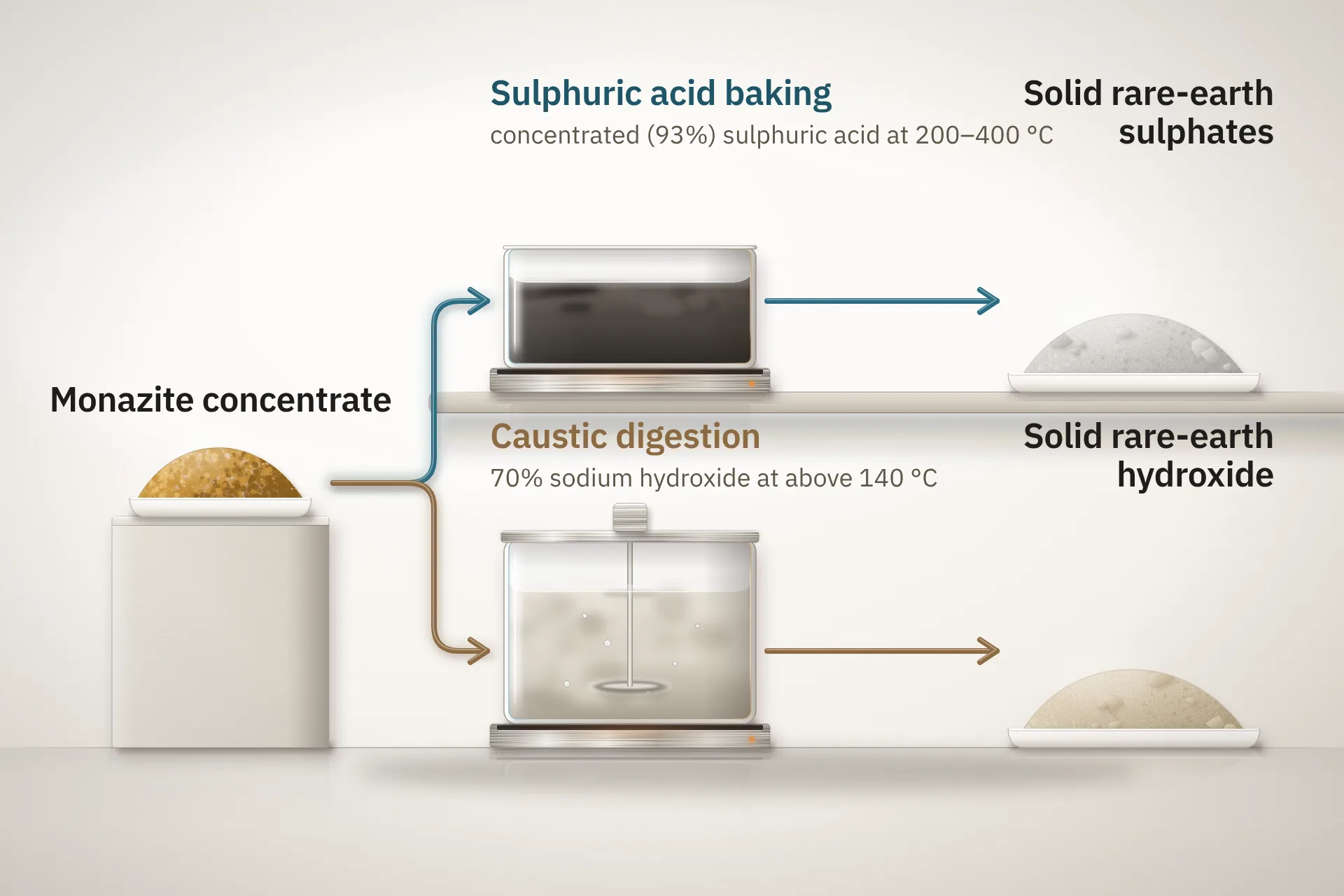
The 2021 paper sets monazite's two conventional routes side by side. In sulphuric acid baking, the paper says, fine monazite is mixed with concentrated (93%) sulphuric acid at 200–400 °C to produce solid rare-earth sulphates. In caustic digestion, the paper says, citing a standard text, fine monazite is mixed with 70% sodium hydroxide at above 140 °C to produce a solid rare-earth hydroxide.
A 2014 review describes how monazite concentrate is decomposed with sodium hydroxide, and the rare-earth hydroxides are then leached with hydrochloric acid to give a mixed rare-earth chloride solution. The phosphate in monazite goes another way: the 2019 review notes that in the caustic route it leaves as trisodium phosphate, a potentially saleable fertiliser-industry product.
The 2021 paper's authors, who describe themselves as a private research and development firm seeking to commercialize their own method, argue that the sulphuric acid route adds sulphates to the tailings, which may reach the environment.
What the bake temperature changes
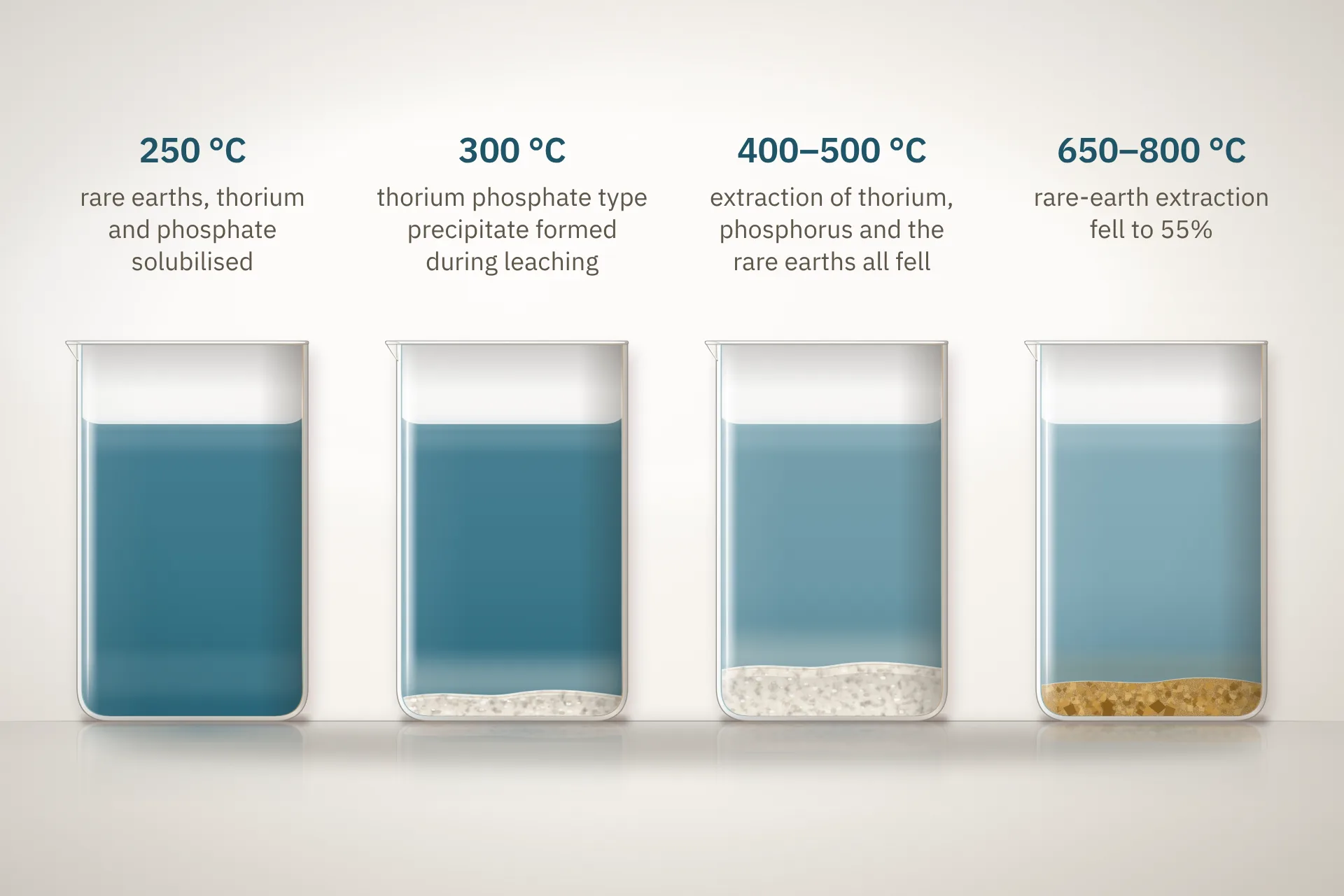
A 2018 laboratory study on a monazite concentrate tested bakes from 200 to 800 °C. In that study, the reaction of monazite concentrate with sulphuric acid was virtually complete after baking at 250 °C for 2 hours, with more than 90% of the rare earths, thorium and phosphate solubilised. In the same study, when the bake was run at 300 °C, a thorium phosphate type precipitate formed during leaching; thorium and phosphate extraction fell sharply, while rare-earth leaching reached nearly 100%.
Above 300 °C, hotter did not help. In the study, at 400–500 °C, extraction of thorium, phosphorus and the rare earths all fell, which the authors attribute to the formation of insoluble thorium–rare-earth polyphosphates. The study reports that between 650 and 800 °C, rare-earth extraction fell to 55%, which appeared to be due to monazite partly re-forming.
In one laboratory study, the same acid at a different bake temperature sent the thorium somewhere else.
Xenotime, bastnäsite and the largest plants
Xenotime appeared to be the slower phosphate in a 2021 laboratory study using condensed phosphoric acid, which is not one of the conventional routes: xenotime appeared to dissolve significantly more slowly than monazite and was still detectable in the residue after 30- and 60-minute leaches. The authors suggest that a possible reason is that xenotime has a different crystal structure from monazite, and say that further investigation is required. Xenotime has also been cracked with the conventional bake: in the 1990s the Malaysian Rare Earth Corporation (MAREC) plant processed xenotime sand concentrate by a sulphuric acid bake, according to the 2019 review.
Bastnäsite is typically heated before it meets acid. The 2014 review says that bastnäsite concentrate is typically calcined to drive off carbon dioxide and fluorine, then treated by two-stage hydrochloric acid digestion followed by sodium hydroxide to produce rare-earth hydroxides.
Among large operations, the 2019 review reports that Mountain Pass switched to caustic conversion when it restarted in 2012, and that about 90% of Bayan Obo (Baotou), China, concentrate is decomposed by a high-temperature sulphuric acid bake, with published bake temperatures varying.
Allanite, the silicate
According to a 2024 study, allanite is a common rare-earth-bearing silicate mineral that has not been economically exploited for rare earths on an industrial scale. The same paper says that conventional sulphuric acid baking of allanite at high temperature (200 to 650 °C), followed by extended water leaching near boiling, works but carries substantial economic and environmental drawbacks.
In its own 2024 laboratory test, on a single concentrate, dilute (2 mol/L) sulphuric acid at 22 °C for 3 hours gave overall recoveries of approximately 80% of the light and 60% of the heavy rare earths, as the study uses those terms, from a coarse metamict allanite-(Ce) concentrate, with thorium, iron, aluminium, silicon and calcium also dissolving. On this publication's reading, the list of other elements that dissolved is part of the difficulty, since everything taken into solution alongside the rare earths travels on to the later steps. A 2024 review adds that allanite has not received widespread attention in mineral processing and that further studies of processing techniques are imperative.
Where the thorium goes
A 2021 paper notes that monazite is weakly radioactive, mainly because it contains thorium and uranium. On this publication's reading, choosing a cracking route is also choosing where that thorium ends up.
In the caustic route as one 2016 review describes it, thorium is leached together with the rare earths, which raises safety concerns at the separation stage, where thorium can be concentrated. In a roasting alternative described in the same review, thorium is converted to an oxide that does not dissolve in dilute hydrochloric acid, so it stays out of the leach liquor. In a 2021 laboratory study of a thorium-bearing bastnäsite ore, thorium formed soluble sulphate during a sulphuric acid bake and precipitated together with the rare earths under all conditions tested, so the thorium followed the rare earths into the precipitate.
A process description W. R. Grace & Co. sent to the US Atomic Energy Commission in February 1968 describes digesting finely ground monazite sand in hot concentrated sulphuric acid to produce rare-earth fractions relatively free from thorium and a thorium fraction relatively free of rare earths. A study of the water-leach purification residue from acid-baked concentrate processed in Malaysia, at the Lynas Advanced Material Plant, found thorium present in several phosphate compounds rather than only as thorium pyrophosphate. And USGS wrote in 2017 that monazite had not been produced from Australian heavy-mineral sands operations since the 1990s, to avoid the concentration of naturally occurring radioactive minerals, primarily because of the thorium in monazite. Iluka said in 2022 that by-product monazite and xenotime from its Narngulu plant had been stored at Eneabba since the early 1990s.
Related
- Ore Processing — the concentrate that arrives at the cracking step
- Processing Technology — the equipment each route runs in
- Metallurgy — what the separated rare earths become
- Countries — where the plants named here sit
- Regulation — the rules that follow thorium out of the plant
Sources
- SECONDARYWatts, H. and Fisher, T., 'Leaching the Unleachable Mineral: Rare Earth Dissolution from Monazite Ore in Condensed Phosphoric Acid', Minerals 11(9), 931, 2021. §1 (introduction): monazite weakly radioactive owing to thorium and uranium; the two conventional routes (sulphuric acid baking, caustic digestion) and their conditions, citing earlier texts; sulphates added to tailings. The authors describe themselves as a private research and development firm commercialising their own method.
- PRIMARYWatts, H. and Fisher, T., Minerals 11(9), 931, 2021, study results. §3.1.3: xenotime dissolution in condensed phosphoric acid relative to monazite; §3.3: the authors' interpretation of the difference.
- SECONDARYDemol, J., Ho, E., Soldenhoff, K. and Senanayake, G., 'The sulfuric acid bake and leach route for processing of rare earth ores and concentrates: A review', Hydrometallurgy 188, 123–139, 2019 (author's accepted manuscript). Abstract: host minerals of most rare-earth reserves; decomposition conditions; impurity rejection. Pp. 9, 12, 13, 20, 22: trisodium phosphate in the caustic route; Bayan Obo bake and purification; Mountain Pass; MAREC xenotime processing in the 1990s.
- PRIMARYDemol, J., Ho, E. and Senanayake, G., 'Sulfuric acid baking and leaching of rare earth elements, thorium and phosphate from a monazite concentrate: Effect of bake temperature from 200 to 800 °C', Hydrometallurgy 179, 254–267, 2018 (author's accepted manuscript). Abstract: laboratory results by bake temperature.
- SECONDARYHaque, N., Hughes, A., Lim, S. and Vernon, C., 'Rare Earth Elements: Overview of Mining, Mineralogy, Uses, Sustainability and Environmental Impact', Resources 3(4), 614–635, 2014. §3.4–3.5 (p. 621): alkaline treatment of monazite; sulphuric acid leaching of monazite; treatment of bastnäsite concentrate.
- SECONDARYPeelman, S., Sun, Z.H.I., Sietsma, J. and Yang, Y., 'Leaching of rare earth elements: review of past and present technologies', in Rare Earths Industry, Elsevier, 2016, pp. 319–334, as reproduced in Peelman, S., PhD thesis, TU Delft, 2019. Table 2.1 (thesis p. 14) and thesis p. 15: hot sulphuric acid digestion of monazite; thorium in the caustic route and in a roasting alternative.
- PRIMARYW. R. Grace & Co., Chemicals Division, 'Process for Breaking Monazite Sands Into Rare Earth and Thorium Compounds', process description sent to the US Atomic Energy Commission, covering letter dated 13 February 1968 (NRC ADAMS ML20063B417).
- PRIMARYKursunoglu, S. et al., 'Production of mixed rare earth oxide powder from a thorium containing complex Bastnasite ore', Powder Technology 379, 641–654, 2021 (university repository copy). Laboratory study: behaviour of thorium during a sulphuric acid bake of a thorium-bearing bastnäsite ore.
- SECONDARYUS Geological Survey, Van Gosen, B.S. et al., 'Rare-Earth Elements', Chapter O of Critical Mineral Resources of the United States, Professional Paper 1802-O, 2017. P. O4: monazite not produced from Australian heavy-mineral sands operations since the 1990s; Bayan Obo.
- SECONDARYKärenlampi, K., Väänänen, E., Roivainen, T. and Perämäki, P., 'Low Temperature Leaching Behavior of Allanite-(Ce) in Treating an Allanite-Concentrate by Sulfuric Acid', Journal of Sustainable Metallurgy 10, 2024. Abstract: allanite's status as a rare-earth source; conventional sulphuric acid baking of allanite.
- PRIMARYKärenlampi, K. et al., Journal of Sustainable Metallurgy 10, 2024, study results. Abstract: laboratory leaching of a metamict allanite-(Ce) concentrate in dilute sulphuric acid at 22 °C.
- SECONDARYXiao, Z. and Zhang, W., 'Review of allanite: Properties, occurrence and mineral processing technologies', Green and Smart Mining Engineering 1(1), 40–52, 2024. Abstract: the state of allanite processing research.
- PRIMARYAziman, E.S. and Ismail, A.F., 'Frontier looking of rare-earth processed residue as sustainable thorium resources', Progress in Nuclear Energy 128, 103471, 2020 (Malaysian ministry repository copy). §3.2: thorium phases in the water-leach purification residue from the Lynas Advanced Material Plant.
- PRIMARYIluka Resources, 2022 release on the Eneabba rare earths refinery (April 2022), PDF p. 7: the Eneabba stockpile of monazite and xenotime, produced as by-product from Iluka's Narngulu mineral processing plant and stored since the early 1990s.
- ANALYSISANALYSIS: the reading that the choice of cracking route is also a choice about where thorium ends up, and that the range of elements dissolved alongside the rare earths in the allanite test is itself part of the processing difficulty, are this publication's framing.Non-public document · no public URL