Minerals Hub / Mining & Production / Why separating rare earths from each other takes so many stages
Mining & Production · Monazite · 5 min read
Why separating rare earths from each other takes so many stages
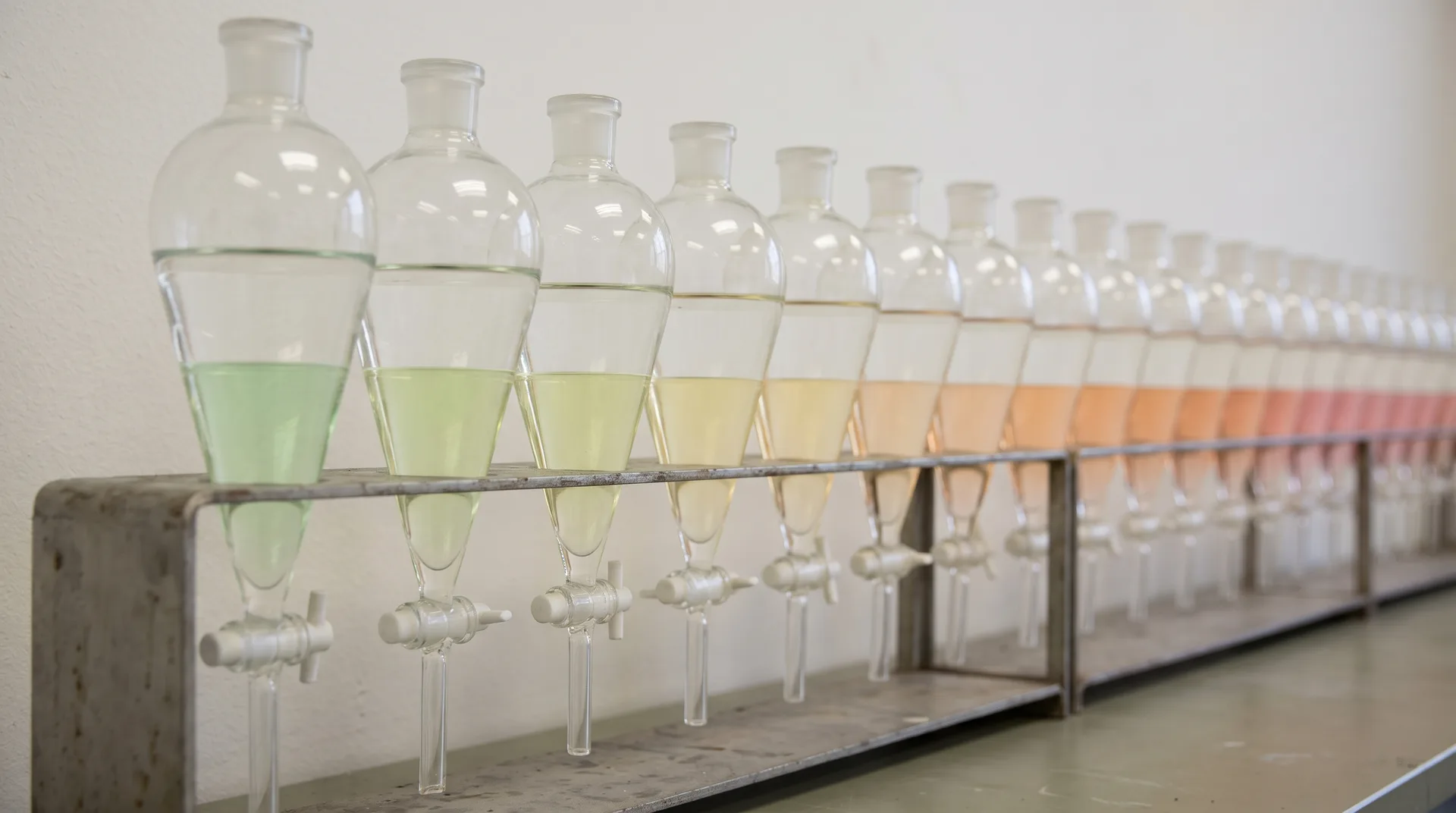
Some neighbouring rare earths differ so slightly that one solvent-extraction stage parts them only a little, and a small separation factor between a pair means a circuit needs many stages.
Reviewed by Peter Uppal
The short version
Rare earths are hard to separate from one another because they differ only subtly in ionic radius and coordination number. A separation factor measures how well two of them part in an extraction, and with the extractant P507 some neighbouring pairs, including neodymium and praseodymium, have factors small enough that reaching high purity requires many equilibrium stages. A 2023 paper in Nature says conventional solvent-extraction circuits require dozens or even hundreds of stages to produce high-purity individual rare-earth oxides.
Neighbours that barely differ
The difficulty starts in the atoms. A 2023 paper in Nature states that rare earths are hard to separate because they differ only subtly in ionic radius and coordination number. The same paper, citing radii published by Shannon in 1976, puts the drop in trivalent ionic radius from lanthanum to lutetium at only about 0.19 Å.
Other authors say the same thing in chemical terms. A 2023 study of extraction columns describes the separation of individual rare earths as hard because their chemical properties are remarkably similar. A 2024 study of separating heavy rare earths, as that study uses the term, attributes the challenge to their closely related electronic structures.
What a separation factor measures
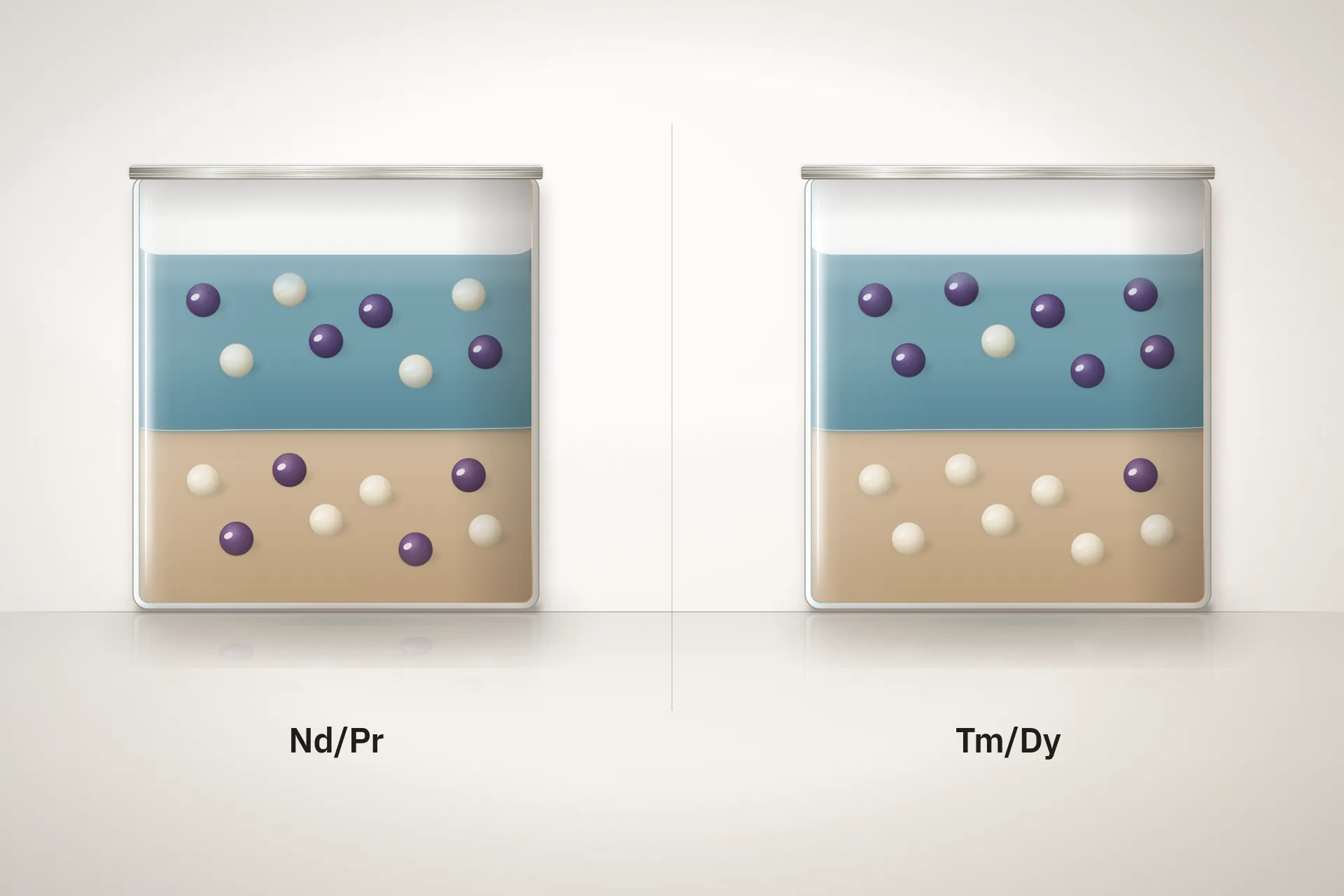
The separation factor (β) between two rare earths is the ratio of their distribution ratios, and characterises how well they separate; a factor close to one means two elements distribute almost identically.
The 2023 column study names the pairs where that matters: for some pairs, including Nd/Pr, Gd/Eu and Lu/Yb, separation factors with the extractant P507 are small, which requires many equilibrium extraction stages to reach high purity. A 2024 paper sharing an author with that study notes that sufficiently high separation factors between adjacent elements are observed in P507 extraction systems; on this publication's reading, the difficulty is pair by pair.
One model makes the cost of a small factor concrete. In a simulated P507 flowsheet in hydrochloric acid, targeting 99.99% praseodymium and neodymium, the Pr/Nd separation required 62 equilibrium stages at a separation factor of 1.70, while simpler bulk splits needed as few as 16 stages. In a different set of calculations, using the extractant TODGA, a 2024 study found cascades of 11 to 18 stages would separate dysprosium, erbium, thulium and ytterbium to about 99.2–99.8% purity, with separation factors at 5.0 mol/L HCl ranging from 3.9 (Tm/Yb) to 41 (Tm/Dy).
The 2023 Nature paper gives the scale for whole circuits. It says conventional solvent-extraction circuits require dozens or even hundreds of stages to produce high-purity individual rare-earth oxides.
A small separation factor is paid for in stages.
Mixer-settlers in series
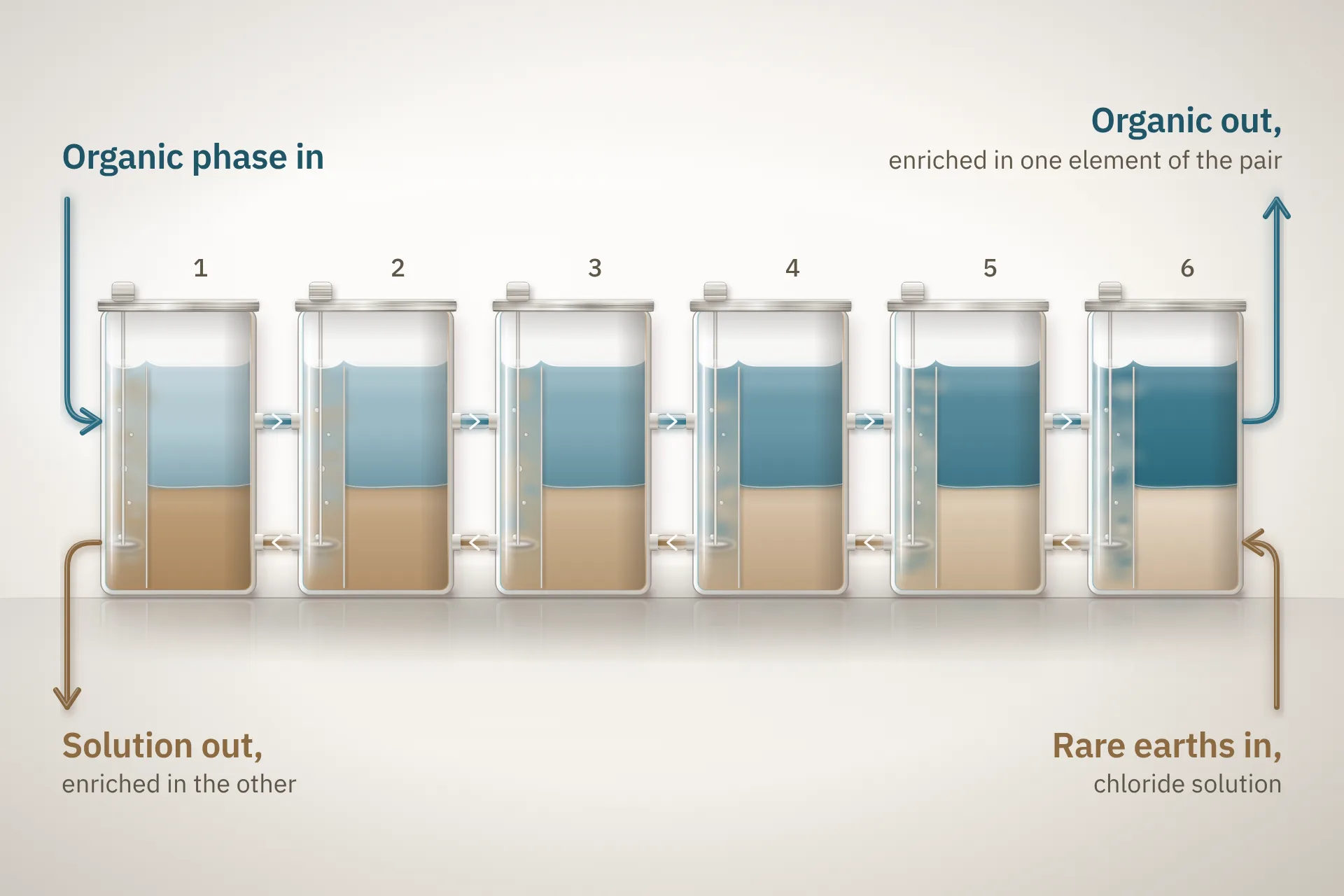
Solvent extraction is the most common industrial method for separating rare earths, according to the 2023 column study, which names extraction columns and cascades of series-connected mixer-settlers as the industrial equipment, with productivity greater by several orders of magnitude than chromatographic devices, a point it makes about extraction apparatus in general. The extracting phase is organic: conventional rare-earth solvent extraction uses organic solvents such as kerosene and phosphonate extractants, and P507 is widely used in the Chinese rare-earth industry.
A small pilot shows the arrangement. In a 2015 study using the extractant DEHPA, the continuous tests were run counter-current in a sequence of mixer-settler stages, using six extraction stages, in a micro continuous pilot plant. The same study found that the Pr/La and Nd/Pr pairs gave small separation factors, which the authors describe as showing how hard these pairs are to separate, in particular for Nd/Pr.
Mixtures of extractants are one line of laboratory work. In a 2024 laboratory study using a 0.9 M equimolar mixture of P507 and Cyanex 272 in chloride solution, the dysprosium/terbium separation factor reached 3.42 at one feed concentration, and ranged from about 1.8 to 3.4 across those tested.
No single order of cuts
Which elements count as heavy depends on who is counting. USGS traditionally defines the heavy rare earths, on the basis of atomic weight, as terbium through lutetium (atomic numbers 65–71), and includes yttrium with them. The simulated praseodymium–neodymium flowsheet draws its light/heavy line elsewhere, between neodymium and samarium, so samarium to gadolinium, which fall outside USGS's heavy group, count as heavy in that flowsheet.
Flowsheets also start in different places. That simulated flowsheet, for liquor from ion-adsorption clay at Jeli in Malaysia, is a four-train design that starts with a bulk light/heavy (LREE/HREE) separation and ends with the Pr/Nd separation, which the authors call the challenging step. The 2024 P507–Cyanex 272 study proposes a flowsheet for what it calls "medium-heavy" rare earths, calculated from a material balance, whose separation order ran Er/Ho, Ho/Dy, Dy/Tb, Tb/Gd and then Er/Y. That proposed design uses five cascades, the first with 25 extraction stages and 15 scrubbing stages, and another with 50 extraction and 30 scrubbing stages.
Capacity and alternatives
The IEA's Global Critical Minerals Outlook 2026 puts China's current share of magnet rare-earth separation at 85%. On this publication's reading, circuits of many stages are one reason a separation plant is a large undertaking.
The 2023 Nature paper names the inefficiency and "large environmental impact" of rare-earth separations as drivers for research into alternatives. In written testimony to the US House Science Committee, an Ames Laboratory scientist said that Ames Laboratory scientists developed the ion-exchange process, which was still used to produce the highest-purity individual elements, while solvent-extraction processes were used for large-scale separation. Counter-current chromatography, the 2023 column study notes, has been used mainly for analytical and preparative purposes (its example is herbal pharmaceutical products); its low productivity has prevented use in large-capacity industrial production, though work aims to scale it with conventional extraction equipment.
The 2023 Nature paper's own route was at laboratory stage: a lanmodulin protein dimer gave Nd/Dy separation factors of about 8 and 13 (two variants). In a single laboratory column stage in that 2023 study, the unmodified dimer upgraded dysprosium in a model e-waste mixture from 5% to 83% purity, as a share of the Nd/Dy mixture, while recovering neodymium at 99.8% purity.
Related
- Processing Technology — the equipment a separation circuit is built from
- Ore Processing — the concentrate a separation plant receives
- Processing Capacity — how separation plants are counted
- Supply Chain Risk — what concentration at one stage means
- New Processing Technologies — routes still in development
Sources
- SECONDARYMattocks, J.A. et al., 'Enhanced rare-earth separation with a metal-sensitive lanmodulin dimer', Nature 618(7963), 87–93, 2023 (Europe PMC full text, PMC10232371). Abstract and introduction: why rare earths are hard to separate; the La–Lu decrease in trivalent ionic radius, citing Shannon (1976); stage counts in conventional circuits; solvents and extractants; drivers for alternatives.
- PRIMARYMattocks, J.A. et al., Nature 618(7963), 87–93, 2023, laboratory results. Methods (PDF p. 17): Nd/Dy separation factors of two lanmodulin dimer variants; single-stage column separation of a model Nd/Dy mixture.
- SECONDARYKostanyan, A.E., Belova, V.V., Tsareva, Y.V. and Petyaeva, M.M., 'Separation of Rare Earth Elements in Multistage Extraction Columns in Chromatography Mode: Experimental Study and Mathematical Simulation', Processes 11(6), 1757, 2023. §1: similarity of rare-earth properties; small separation factors with P507 for some pairs; solvent extraction as the most common industrial method; industrial extraction equipment; counter-current chromatography.
- SECONDARYBai, Y. et al., 'Theoretical Calculations and Experimental Investigation of Separation of Dy3+, Er3+, Tm3+ and Yb3+ by Cascade Extraction in TOGDA–Kerosene/Hydrochloric Acid System', Separations 11, 33, 2024. §1: heavy rare earths and electronic structure; light and heavy groups; P507 in Chinese industry; separation techniques.
- PRIMARYBai, Y. et al., Separations 11, 33, 2024, calculated cascade designs (p. 6): TODGA separation factors at 5.0 mol/L HCl and calculated stage numbers for Dy, Er, Tm and Yb.
- SECONDARYAfonin, M.A., Nechaev, A.V., Yakimenko, I.A. and Belova, V.V., 'Extraction of Rare Earth Elements from Chloride Solutions Using Mixtures of P507 and Cyanex 272', Compounds 4(1), 172–181, 2024. §2: definition of the separation factor; separation factors in P507 systems.
- PRIMARYAfonin, M.A. et al., Compounds 4(1), 172–181, 2024, laboratory results and proposed flowsheet. §3 (pp. 6–7, Table 7): Dy/Tb separation factors with a 0.9 M P507–Cyanex 272 mixture; a proposed five-cascade flowsheet for a medium-heavy feed, calculated from material balance.
- PRIMARYZulkifli, N., Shoparwe, N.F., Yusoff, A.H., Abdullah, A.Z. and Ahmad, M.N., 'Flowsheet Design and Modelling for High Purity Praseodymium and Neodymium by Solvent Extraction', Kompleksnoe Ispolzovanie Mineralnogo Syra, DOI 10.31643/2027/6445.35 (IIUM repository copy). Abstract: spreadsheet simulation of a four-train P507–HCl flowsheet for ion-adsorbed clay liquor from Jeli, Malaysia.
- PRIMARYNascimento, M., Valverde, B.M., Ferreira, F.A., Gomes, R. de C. and Soares, P.S.M. (CETEM), 'Separation of rare earths by solvent extraction using DEHPA', REM: International Engineering Journal 68(4), 427–434, 2015. §2.5 and p. 4: micro continuous pilot plant; separation factors for Pr/La and Nd/Pr.
- PRIMARYUS Geological Survey, Van Gosen, B.S. et al., 'Rare-Earth Elements', Chapter O of Critical Mineral Resources of the United States, Professional Paper 1802-O, 2017. P. O2: definition of the heavy rare-earth elements.
- PRIMARYInternational Energy Agency, Global Critical Minerals Outlook 2026, July 2026. China's share of magnet rare earth separation.
- SECONDARYGschneidner, K.A. Jr. (Ames Laboratory), written testimony 'Energy Critical Elements: The Rare Earths', posted by the US House Committee on Science, Space, and Technology. Pp. 1–2: ion exchange and solvent extraction.
- ANALYSISANALYSIS: the reading that the difficulty of separation is pair by pair (Kostanyan et al. 2023 and Afonin et al. 2024 set side by side), and the link between stage count and the scale of a separation plant, are this publication's framing.Non-public document · no public URL