Minerals Hub / Applications & Industries / Where yttrium is used, from lasers to cancer therapy
Applications & Industries · Xenotime · 5 min read
Where yttrium is used, from lasers to cancer therapy
Yttrium turns up in laser crystals, display phosphors, heat-shielding ceramics and a liver-tumour treatment; this explainer takes each use in turn, then the minerals that carry the element and where it sits on the EU lists.
Reviewed by Peter Uppal
The short version
Yttrium is commonly regarded as a rare-earth element, and USGS's Mineral Commodity Summaries 2026 names ceramics and phosphors as its leading US and global end uses in 2025, with yttrium-aluminium-garnet laser crystals among the lesser amounts consumed. The radioactive isotope yttrium-90 is contained in microspheres that the US Food and Drug Administration approved in 2002 and 2021 for specified liver-tumour indications. On this publication's reading, the element does a different job in each of these uses.
A light element in the heavy group
USGS's 2017 rare-earth chapter says yttrium is commonly regarded as a rare-earth element because it shares chemical and physical similarities with the lanthanides, and that it typically occurs in the same deposits as other rare-earth elements. Although light by atomic number (39), yttrium is included with the heavy rare earths (terbium to lutetium, plus yttrium, on USGS's definition) because of its chemical and physical affiliations with them.
The European Commission's 2023 criticality study also places yttrium among the heavy rare earths, on its own definition, listing dysprosium, erbium, europium, gadolinium, holmium, lutetium, terbium, thulium, ytterbium and yttrium, with scandium assessed separately.
The lattice inside a laser
USGS's Mineral Commodity Summaries 2026 (MCS 2026) lists "yttrium-aluminum-garnet crystals used in lasers for communication, industrial, and medical applications" among the lesser amounts of yttrium consumed. A 1976 thesis at the US Air Force Institute of Technology records that Geusic and co-workers demonstrated laser action in neodymium-doped yttrium aluminium garnet, Nd:YAG.
In Nd:YAG, neodymium ions replace yttrium ions in the garnet structure, so the yttrium-bearing garnet is the host crystal and neodymium the dopant. The Air Force thesis describes YAG's high thermal conductivity and low thermal expansion as highly desirable in a laser host, and the crystal as hard enough to machine and polish.
Phosphors and screens
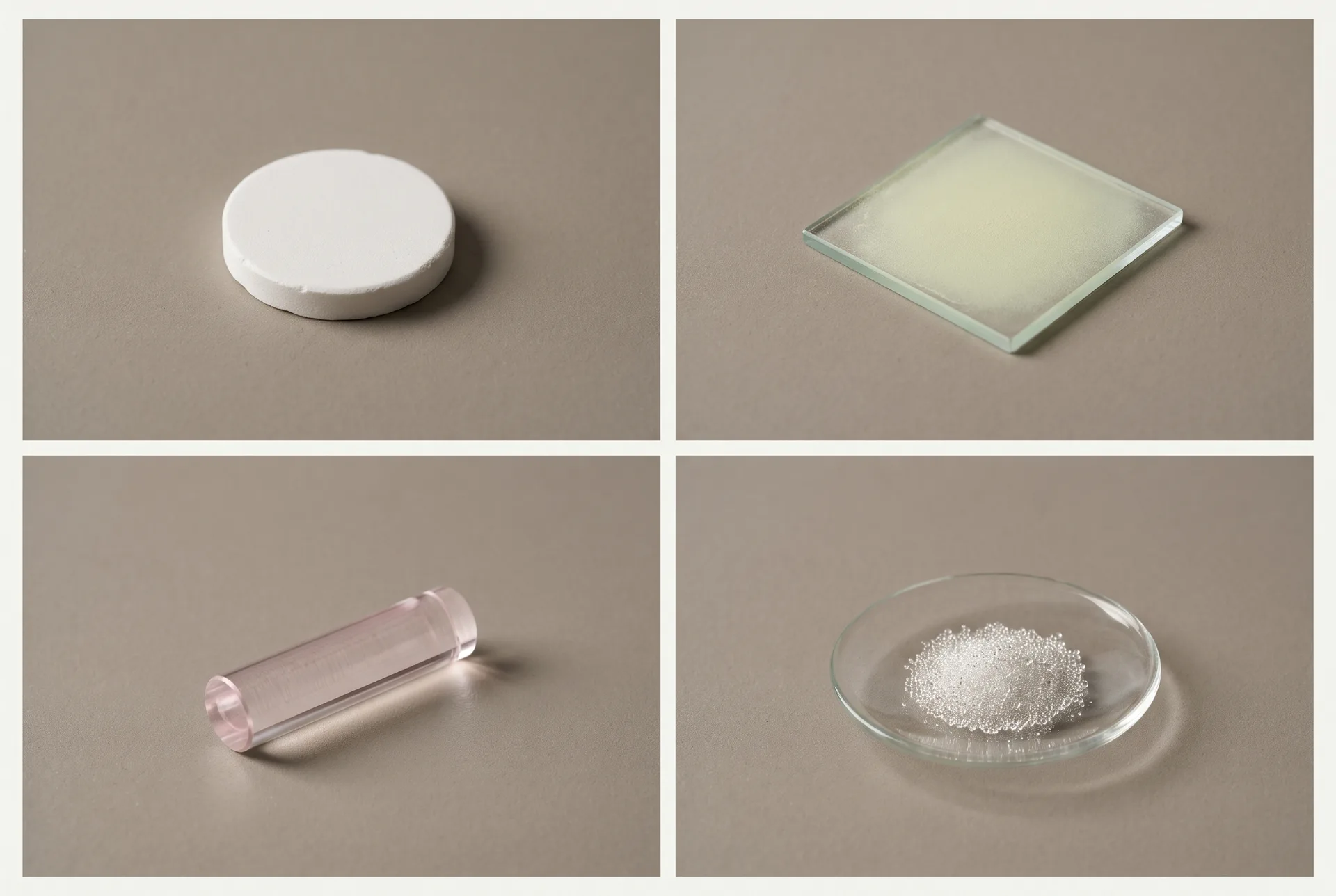
USGS's 2017 chapter listed yttrium, with cerium, lanthanum, europium and terbium, as used to make phosphors for cathode-ray-tube and flat-panel display screens. USGS's MCS 2026 reports that ceramics and phosphors were the leading US and global end uses of yttrium in 2025, and that, in most uses, especially electronics, lasers and phosphors, yttrium is generally not subject to direct substitution.
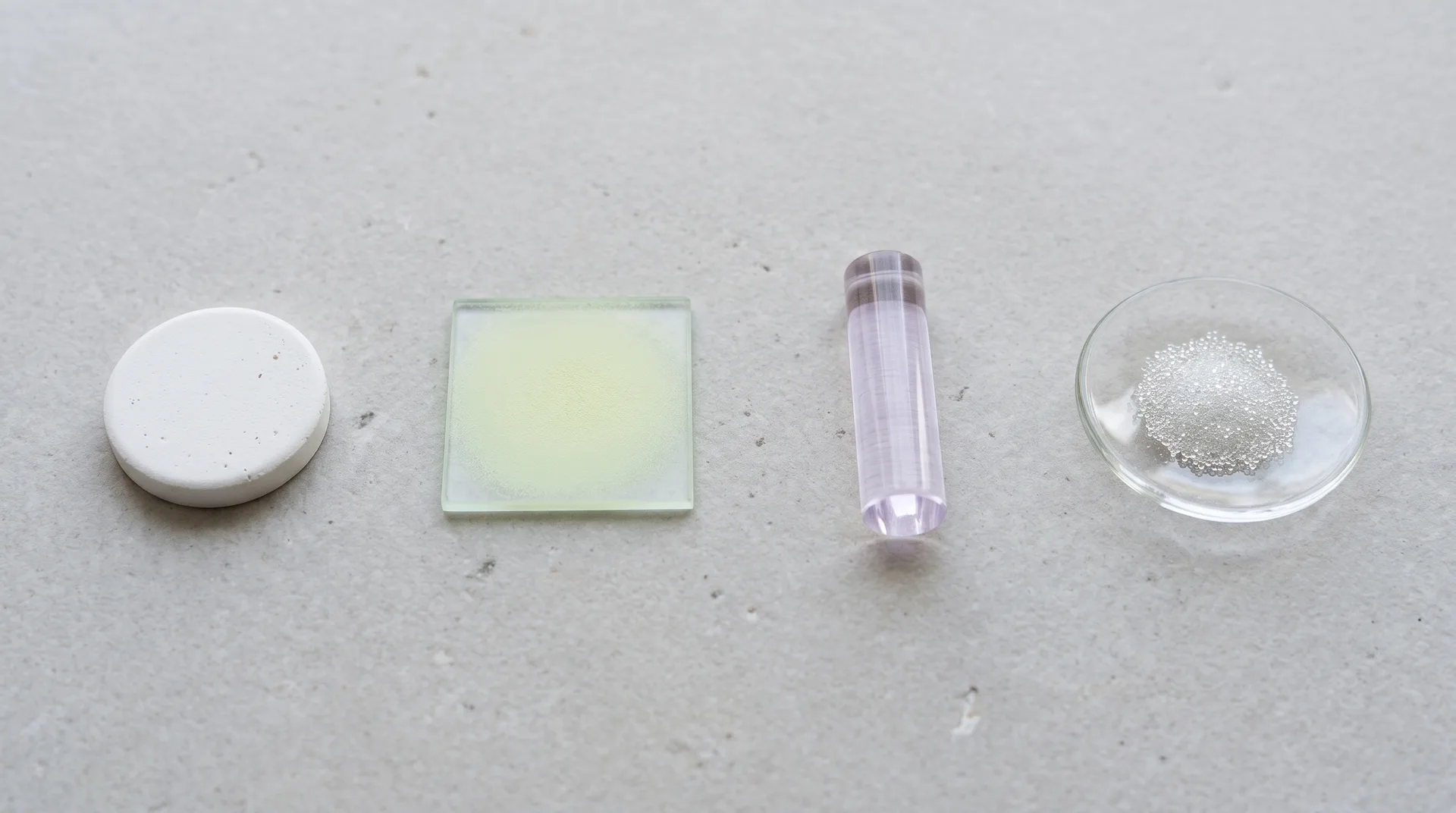
On this publication's reading: a laser host, a phosphor, a zirconia stabiliser and a radiation source, four different jobs.
What yttria does to zirconia
A 2003 NASA technical brief on zirconia thermal barriers says that yttria, the oxide of yttrium, helps keep zirconia in a so-called "non-transformable" tetragonal phase, preventing transformation to the monoclinic phase and the volume change that goes with it. USGS's MCS 2026 says that, as a stabiliser in zirconia ceramics, Y₂O₃ may be substituted with calcium oxide or magnesium oxide, but the substitutes generally impart lower toughness.
Yttrium-90 in the liver
The medical use depends on a radioactive isotope. The IAEA's 2009 report on radionuclide generators states that yttrium-90 can be prepared by irradiating yttrium-89 in a nuclear reactor or by the decay of strontium-90. FDA's TheraSphere record describes it as a pure beta emitter that decays to stable zirconium-90 with a physical half-life of 64.1 hours (2.67 days).
The first of two devices described here is TheraSphere, which in FDA's description consists of insoluble glass microspheres in which yttrium-90 is an integral constituent of the glass. FDA approved TheraSphere (PMA P200029) on 17 March 2021 as selective internal radiation therapy for local tumour control of solitary tumours (1–8 cm) in patients with unresectable hepatocellular carcinoma, with further eligibility conditions on liver function and patient condition set out in the record.
The second is SIR-Spheres (PMA P990065), approved by FDA on 5 March 2002 and described as radioactive microspheres containing yttrium-90, indicated for unresectable metastatic liver tumours from primary colorectal cancer with adjuvant intra-hepatic artery chemotherapy of floxuridine. A March 2019 draft report by an advisory committee of the US Nuclear Regulatory Commission describes SIR-Spheres as resin microspheres containing yttrium-90. The SIR-Spheres record notes that Y-90's beta radiation is one to which liver tumours, as well as healthy liver tissue, are sensitive.
Where the yttrium comes from
USGS's MCS 2026 says large resources of yttrium in monazite and xenotime are available worldwide in placer deposits, carbonatites, uranium ores and weathered clay (ion-adsorption) deposits. USGS's 2017 chapter identifies xenotime (YPO₄) and monazite as common rare-earth and yttrium-bearing phosphate minerals in metamorphic deposits, and describes ion-adsorption clay deposits in southern China as the world's primary source of the heavy rare earths.
USGS's MCS 2026 estimated 2025 world mine production of yttrium, as Y₂O₃ equivalent in rare-earth concentrates, at 10,000 to 15,000 tonnes. USGS's MCS 2026 also estimated that China produced most of the world's yttrium supply in 2025 and that Burma (Myanmar) produced a significant percentage, with global Y₂O₃ reserves not quantified. USGS's MCS 2026 reported that, for data year 2025, there were no fully commercial facilities in the United States that could separate or refine yttrium. USGS's MCS 2026 records that in April 2025 China tightened its export controls on rare-earth elements, with specific controls on yttrium.
Where yttrium sits on the lists
The risk framework in the IEA's Global Critical Minerals Outlook 2026, published in July 2026, ranks yttrium among the materials most exposed to supply vulnerabilities, citing high supply concentration, limited substitution and importance across end uses.
As of 26 October 2026, yttrium is not listed as a strategic raw material, as set out in the Regulation's annexes: Annex I's rare-earth entry in the Critical Raw Materials Act is "rare earth elements for permanent magnets (Nd, Pr, Tb, Dy, Gd, Sm, and Ce)", and Annex II lists heavy rare earth elements, light rare earth elements and scandium as separate critical entries.
Related
- Medical Technologies — where yttrium-90 sits among medical uses of minerals
- Aerospace — the zirconia coatings that yttria stabilises
- Refining — how yttrium is separated from the other rare earths
- Export Controls — China's April 2025 controls, which include yttrium
- Critical Mineral Strategies — the EU lists and where yttrium falls on them
Sources
- PRIMARYU.S. Geological Survey, Van Gosen, B.S. and others, 'Rare-Earth Elements', Chapter O of Critical Mineral Resources of the United States, Professional Paper 1802-O, 2017. Printed p. O2: yttrium commonly regarded as a rare-earth element; typically in the same deposits; included with the heavy rare earths although light. p. O3: uses in laser crystals and display phosphors. p. O8 and Table O2: xenotime and monazite as rare-earth and yttrium-bearing phosphates. pp. O1, O16: ion-adsorption clays in southern China as the primary source of the heavy rare earths.
- SECONDARYMaupin, W.B. II, Output Power Variations in Nd:YAG Laser Hosts, MSc thesis GEP/PH/76-8, Air Force Institute of Technology, December 1976, DTIC scan. Chapters I and II: laser action in Nd:YAG demonstrated by Geusic and co-workers; neodymium ions replacing yttrium ions in the garnet structure; YAG's thermal and mechanical properties as a laser host.
- PRIMARYU.S. Geological Survey, Mineral Commodity Summaries 2026, Yttrium (Johnston, S.N.), February 2026, current edition. p. 1: leading end uses in 2025; yttrium-aluminum-garnet laser crystals among lesser amounts consumed; no fully commercial US separation or refining facilities. p. 2: substitutes; resources; estimated 2025 world mine production as Y₂O₃ equivalent in rare-earth concentrates; China and Burma (Myanmar); April 2025 export controls.
- PRIMARYNASA Tech Briefs, 'Scandia-and-Yttria-Stabilized Zirconia for Thermal Barriers', LEW-16789 (Mess, D., Cambridge Microtech, for NASA Glenn), October 2003, p. 20: yttria keeping zirconia in a non-transformable tetragonal phase.
- PRIMARYInternational Atomic Energy Agency, Therapeutic Radionuclide Generators: 90Sr/90Y and 188W/188Re Generators, Technical Reports Series No. 470, 2009, printed p. 4: preparation of yttrium-90 by reactor irradiation of yttrium-89 or by decay of strontium-90.
- PRIMARYU.S. Food and Drug Administration, Summary of Safety and Effectiveness Data, TheraSphere Y-90 Glass Microspheres, PMA P200029 (approved 17 March 2021). p. 1: indication; p. 4: device description and yttrium-90 decay properties.
- PRIMARYU.S. Food and Drug Administration, PMA approval letter, TheraSphere, P200029, 17 March 2021.
- PRIMARYU.S. Food and Drug Administration, Summary of Safety and Effectiveness Data, SIR-Spheres, PMA P990065 (approved 5 March 2002), p. 1: device description, indication, and the sensitivity of liver tumours and healthy liver tissue to yttrium-90 beta radiation.
- PRIMARYU.S. Nuclear Regulatory Commission, Advisory Committee on the Medical Use of Isotopes, Subcommittee on Y-90 Microsphere Brachytherapy, draft report on licensing guidance Revision 10, 11 March 2019 (ADAMS ML19091A240). pp. 1–2: glass and resin yttrium-90 microspheres.
- PRIMARYRegulation (EU) 2024/1252 of the European Parliament and of the Council of 11 April 2024 (Critical Raw Materials Act), Official Journal L series, 3 May 2024. Annex I, Section 1 (strategic raw materials), rare-earth entry; Annex II, Section 1 (critical raw materials), entries for heavy rare earth elements, light rare earth elements and scandium.
- PRIMARYEuropean Commission, DG GROW (Grohol, M. and Veeh, C.), Study on the Critical Raw Materials for the EU 2023: Final Report, Publications Office, 2023, DOI 10.2873/725585. pp. 5, 47: heavy rare earths as assessed, including yttrium; scandium assessed separately. A Commission study, not legal text.
- PRIMARYInternational Energy Agency, Global Critical Minerals Outlook 2026, July 2026. Executive summary, p. 9: yttrium among the materials most exposed to supply vulnerabilities in the report's risk framework.
- ANALYSISANALYSIS: the framing that yttrium does a different job in each of its main uses (laser host, phosphor, zirconia stabiliser, radiation source) is this publication's.Non-public document · no public URL