Minerals Hub / Applications & Industries / Rare earths are not rare in rock, but their ore deposits are unusual
Applications & Industries · Monazite · 6 min read
Rare earths are not rare in rock, but their ore deposits are unusual
What the rare earths are, whose definitions set their boundaries, why ‘rare’ misleads, and which four the IEA singles out for magnets.
Reviewed by Peter Uppal
The short version
The rare earths are a group of chemically similar metals: 17 in the British Geological Survey's definition, the 15 lanthanides plus scandium and yttrium, while some USGS publications leave scandium out. A USGS professional paper says they are not rare in terms of average crustal abundance, but concentrated and economic deposits of them are unusual. The IEA groups four of them, neodymium, praseodymium, dysprosium and terbium, as magnet rare earths, and USGS reports magnets as the estimated leading global use of rare earths.
Seventeen elements, or fewer, depending on who counts
The British Geological Survey defines the rare earth elements as a group of 17 chemically similar metallic elements, including the 15 lanthanides, scandium and yttrium. An undated USGS summary page gives the same total, describing a relatively abundant group of 17 elements composed of scandium, yttrium, and the lanthanides.
Other USGS publications draw the group differently. A 2017 professional paper says the rare earths comprise 15 elements, from lanthanum (atomic number 57) to lutetium (71), commonly referred to as the lanthanides, adds that yttrium is commonly regarded as an REE, and does not list scandium in its table of them. A 2002 USGS fact sheet delineates 16 rare earth elements: the lanthanides, La through Lu, plus Y.
The 2017 paper leaves promethium out of its discussion of rare-earth deposits because the element "is extremely rare and unstable in nature". The 2002 fact sheet says promethium has no long-lived isotopes and occurs naturally on Earth only in vanishingly small quantities, and the BGS profile describes it as a radioactive element.
Light and heavy is a line drawn in different places
USGS Professional Paper 1802-O says the rare earths are traditionally divided by atomic weight into light (lanthanum to gadolinium, 57 to 64) and heavy (terbium to lutetium, 65 to 71). In the same paper, yttrium, although light (atomic number 39), is included with the heavy group because of its common chemical and physical affiliations with the other heavy rare earths. USGS's Mineral Commodity Summaries 2026 lists terbium, dysprosium, holmium, erbium, thulium, ytterbium and lutetium as heavy rare-earth elements, and says yttrium is considered a heavy rare-earth element.
The British Geological Survey's 2011 profile says the lanthanides are commonly divided into light (lanthanum to europium) and heavy (gadolinium to lutetium, plus yttrium), and calls the division "somewhat arbitrary". The 2002 USGS fact sheet also placed gadolinium on the heavy side: Gd to Lu, plus Y. Gadolinium is therefore light in one USGS publication and heavy in another.
Annex II of Regulation (EU) 2024/1252, the Critical Raw Materials Act, lists heavy rare earth elements and light rare earth elements as two separate critical raw materials, with scandium as a third, separate entry.
Ask which elements are rare earths, and a careful answer begins with whose definition.
Why they occur together
USGS explains that the rare earths are commonly found together in Earth's crust because they share a trivalent charge (REE³⁺) and similar ionic radii. The 2002 USGS fact sheet describes yttrium's geochemical behaviour as "virtually identical to that of the heavier lanthanides".
Common in the crust, unusual in ore
Professional Paper 1802-O states the point directly: REEs are not rare in terms of average crustal abundance, but concentrated and economic deposits of REEs are unusual. The same paper notes that cerium is the most abundant REE, and it is actually more common in Earth's crust than is copper or lead.
The undated USGS summary page gives the range in figures, from cerium, the 25th most abundant of the 78 common elements in the crust at 60 parts per million, to thulium and lutetium, the least abundant rare earths at about 0.5 part per million. By the 2002 fact sheet's comparison, even the two least abundant (Tm, Lu) are nearly 200 times more common than gold. The same fact sheet calls the name itself "a historical misnomer; persistence of the term reflects unfamiliarity rather than true rarity".
The sources locate the difference in concentration. The fact sheet says the more abundant rare earths are each similar in crustal concentration to commonplace industrial metals such as chromium, nickel, copper, zinc, molybdenum, tin, tungsten or lead, but have "very little tendency to become concentrated in exploitable ore deposits". Mineral Commodity Summaries 2026 puts it comparatively: rare earths are relatively abundant in the Earth's crust, but minable concentrations are less common than for most other mineral commodities.
The minerals that carry them
BGS states that the vast majority of resources are associated with just three minerals: bastnäsite, monazite and xenotime. The USGS summary page gives a different list of principal economic sources: the minerals bastnäsite, monazite and loparite, and the lateritic ion-adsorption clays.
According to the 2017 paper, monazite is the principal REE mineral recovered by placer mining operations, particularly in coastal deposits, and the 2002 fact sheet says it generally contains elevated levels of thorium. Xenotime, a phosphate, is one of the common REE-yttrium-bearing minerals in metamorphic deposits, alongside monazite; BGS adds that xenotime is dominated by the heavier REE including Y, Dy, Er, Yb and Ho. USGS (2017) describes ion-adsorption clay deposits in southern China as the world's primary sources of the heavy rare earths, and USGS (2026) says heavy rare earths are less abundant than light rare earths but are elevated in some ores, including ion-adsorption clays.
Four elements and a magnet
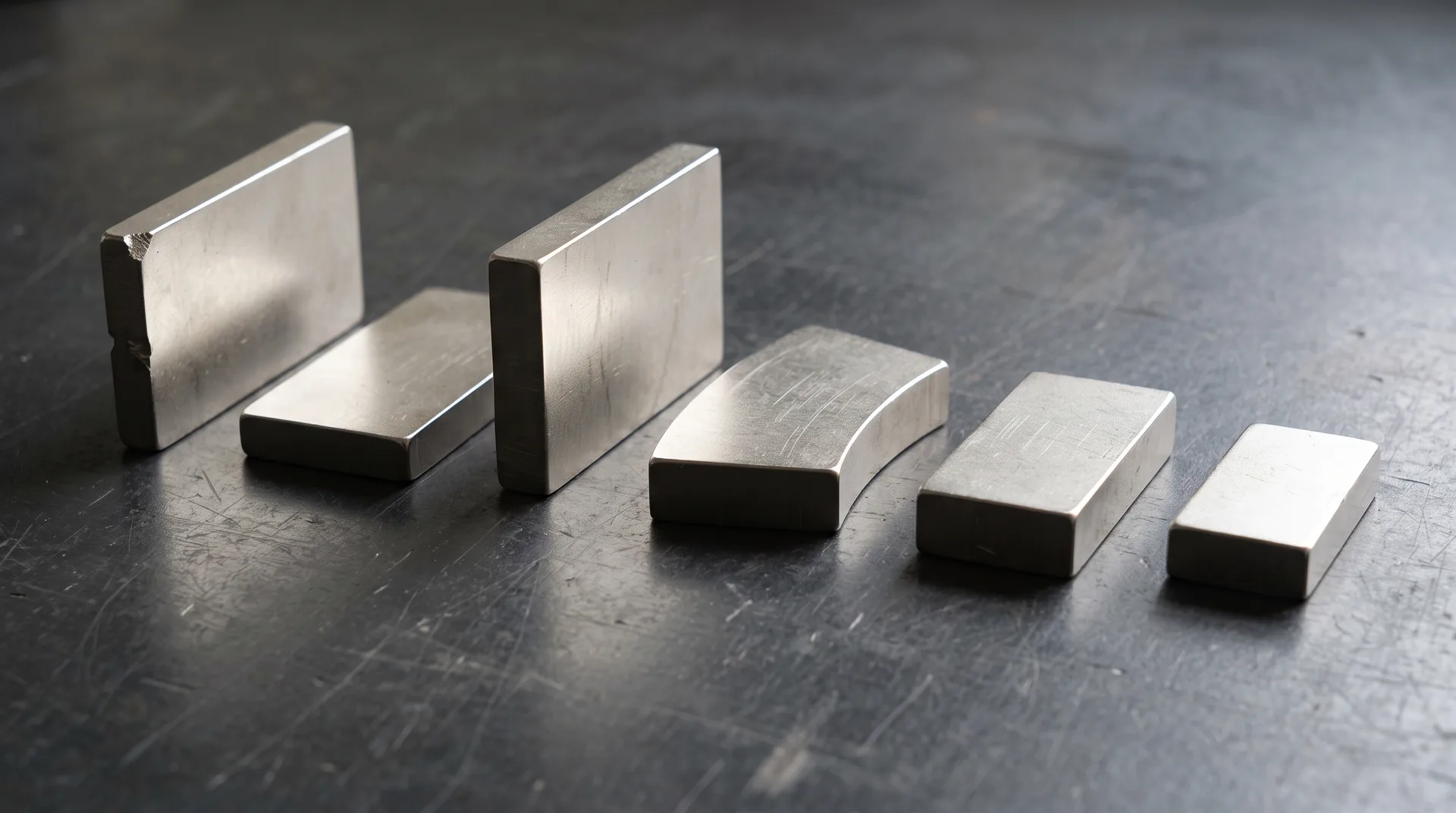
USGS's 2026 edition reports that the estimated leading global use of rare earths was magnets. USGS (2017) describes neodymium-iron-boron magnets as "the strongest magnets known", used wherever space and weight are at a premium. Dysprosium matters there, the same paper says, because substituting it for a small portion of neodymium improves high-temperature performance and resistance to demagnetisation. BGS notes that many magnets tend to lose their magnetism as they heat up, but the addition of dysprosium or terbium prevents this from happening at high temperatures.
The IEA's 2026 report treats neodymium, praseodymium, dysprosium and terbium as magnet rare earths, and its figures show how much a share depends on the stage measured: in 2024 China accounted for 60% of global mined production of magnet rare earths and 91% of global refined output of them. At magnet manufacture, the IEA finds that China's share of sintered permanent magnet production rose from around 50% in 2005 to 94% in 2024.
The strategic list in Annex I of the EU's Act, the narrower of its two lists, has one rare-earth entry: rare earth elements for permanent magnets (Nd, Pr, Tb, Dy, Gd, Sm, and Ce), seven elements where the IEA's magnet group has four.
Related
- Critical Mineral Strategies — how governments list the rare earths, and in which groups
- Processing Capacity — the stages between mined and refined output, where supply shares differ
- Supply Chain Risk — what concentration at a single stage does to an exposure
- Exploration — how a rare-earth deposit is found and sampled
- Ore Processing — how monazite and the other host minerals are separated
Sources
- PRIMARYBritish Geological Survey (Walters, A. and Lusty, P.), 'Rare Earth Elements', MineralsUK commodity profile, November 2011, via the NERC Open Research Archive. p. 1: definition of the rare earth elements as 17 chemically similar metals (15 lanthanides, scandium, yttrium); promethium as radioactive (footnote 1); light/heavy division ('commonly divided', 'somewhat arbitrary'). p. 3: three minerals hosting the vast majority of resources; xenotime dominated by the heavier REE. p. 19: dysprosium and terbium in magnets at high temperature.
- SECONDARYU.S. Geological Survey, National Minerals Information Center, 'Rare Earths Statistics and Information' (web page, undated). Introductory paragraph: rare earths as a group of 17 elements; crustal abundance range from cerium (60 ppm) to thulium and lutetium (about 0.5 ppm); principal economic sources. An undated summary page, so tagged SECONDARY.
- PRIMARYVan Gosen, B.S., Verplanck, P.L., Seal, R.R., II, Long, K.R., and Gambogi, J., 2017, Rare-Earth Elements, chap. O of U.S. Geological Survey Professional Paper 1802. p. O2: REEs as 15 elements from lanthanum (57) to lutetium (71); yttrium commonly regarded as an REE; promethium excluded from deposit discussions; traditional light/heavy division by atomic weight; yttrium grouped with the heavy REEs. p. O3: not rare in average crustal abundance but economic deposits unusual; cerium more common than copper or lead; neodymium-iron-boron magnets; dysprosium substitution. p. O6: shared trivalent charge and similar ionic radii. p. O8: xenotime and monazite in metamorphic deposits. p. O10: monazite in placer mining. p. O16: ion-adsorption clays in southern China. Scandium is absent from Table O1.
- PRIMARYHaxel, G.B., Hedrick, J.B., and Orris, G.J., 2002, Rare Earth Elements: Critical Resources for High Technology, U.S. Geological Survey Fact Sheet 087-02. Figure 2 caption: 16 rare earth elements (La through Lu, plus Y); yttrium's geochemical behaviour virtually identical to the heavier lanthanides; promethium has no long-lived isotopes. Main text: 'historical misnomer'; Tm and Lu nearly 200 times more common than gold; comparison with commonplace industrial metals and very little tendency to concentrate in ore deposits; heavy REE defined as Gd to Lu, Y; monazite generally contains elevated thorium.
- PRIMARYU.S. Geological Survey, Mineral Commodity Summaries 2026, Rare Earths (February 2026, current edition). Domestic Production and Use: estimated leading global use was magnets. World Resources: relatively abundant in the crust, minable concentrations less common than for most other mineral commodities.
- PRIMARYU.S. Geological Survey, Mineral Commodity Summaries 2026, Rare Earths (Heavy) (February 2026, current edition). Domestic Production and Use, first sentence: terbium to lutetium as heavy rare-earth elements; footnote 1: yttrium considered a heavy rare-earth element. World Resources: heavy rare earths less abundant than light but elevated in some ores, including ion-adsorption clays.
- PRIMARYRegulation (EU) 2024/1252 of the European Parliament and of the Council of 11 April 2024 (Critical Raw Materials Act), Official Journal L series, 3.5.2024, EUR-Lex HTML of the OJ text. Annex I, Section 1, entry (n): 'rare earth elements for permanent magnets (Nd, Pr, Tb, Dy, Gd, Sm, and Ce)'. Annex II, Section 1, entries (q) 'heavy rare earth elements', (r) 'light rare earth elements' and (ab) 'scandium'.
- PRIMARYInternational Energy Agency, Rare Earth Elements: Pathways to secure and diversified supply chains, IEA (2026), executive summary (CC BY 4.0). Magnet rare earths defined as neodymium, praseodymium, dysprosium and terbium; China's 2024 shares of global mined production (60%) and refined output (91%) of magnet rare earths; China's share of sintered permanent magnet production, around 50% in 2005 and 94% in 2024.
- ANALYSISANALYSIS: the framing that both the membership of the rare-earth group and its light/heavy boundary depend on whose definition is used is this publication's reading of the sources above.Non-public document · no public URL