Minerals Hub / Applications & Industries / Why some welding rods are coated in rutile
Applications & Industries · Rutile · 4 min read
Why some welding rods are coated in rutile
A small share of US titanium mineral concentrates ends up wrapped around a welding electrode, and this piece explains what the rutile in that coating does to the arc, the slag and the finished weld.
Reviewed by Peter Uppal
The short version
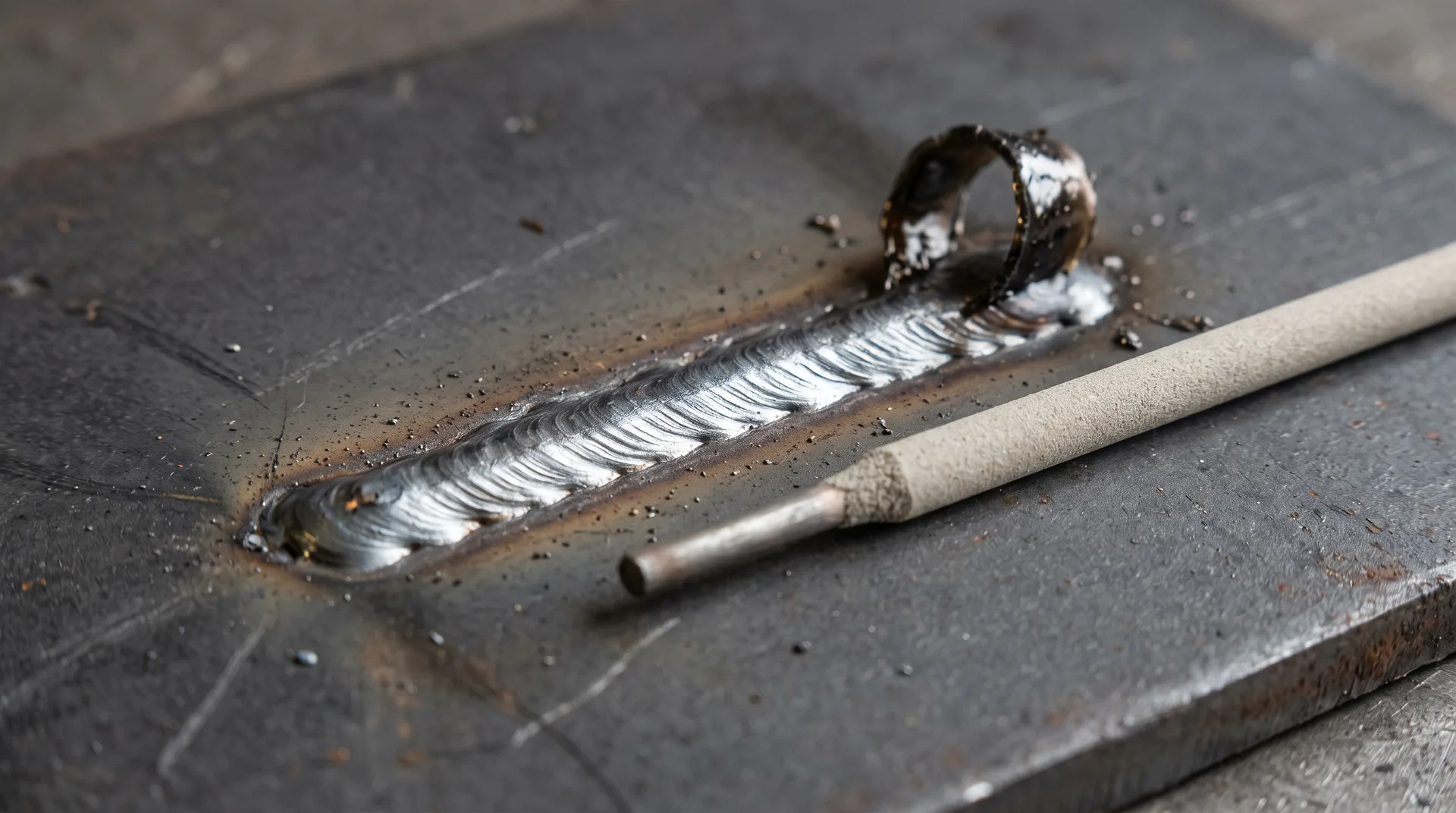
A manual metal arc electrode is a filler rod with a flux coating, and that coating has to shield the weld from the air, steady the arc and leave a slag over the cooling metal. TWI, a research and technology organisation, says rutile coatings typically contain around 50% rutile, and its guidance credits the titanium oxide with easy arc ignition, a smooth arc, low spatter and slag that is easily removed. USGS reports that in the United States in 2025 more than 95% of titanium mineral concentrates went to pigment, and welding-rod coatings are one of the uses that took the remainder.
A small use, but a named one
In the United States, welding is one of the small uses left once pigment is counted. USGS's Mineral Commodity Summaries 2026 says more than 95% of titanium mineral concentrates were consumed by domestic TiO₂ pigment producers in 2025, and that the remainder was used in welding-rod coatings and for manufacturing carbides, chemicals, and titanium metal. It gives no separate share for welding. USGS also lists several competing feeds: it states that ilmenite, leucoxene, rutile, slag, and synthetic rutile compete as feedstock sources for producing TiO₂ pigment, titanium metal, and welding-rod coatings. The 2014 USGS deposit model lists zircon and zirconium oxide among uses including abrasives, chemicals, metal alloys, and welding rod coatings.
Producers name the market too. Iluka says it sells natural rutile for end use in pigment, welding and many other applications, and calls welding a further key market of high grade titanium feedstocks. Sierra Rutile says rutile is primarily used as a pigment and describes it as an element in welding electrodes.
What the coating has to do
The flux around the rod does several jobs at once. TWI's guidance on welding consumables says the flux must prevent atmospheric contamination of the electrode tip, the filler metal crossing the arc, and the molten weld pool, and that it generally does this by decomposing in the heat of the arc to form a protective gaseous shield. It must also remove any oxide film and transfer alloying elements across the arc, and should aid arc striking and arc stability.
TWI's consumables guidance also says the flux should produce a slag that shapes the molten pool and, where needed, holds it in place during positional welding, and that any slag should be readily removable and preferably self-detaching.
What rutile adds
TWI says rutile coatings contain a large amount of rutile, titanium dioxide, typically around 50%, alongside cellulose, limestone, silica, mica, ferro-manganese and some moisture. Its guidance on the manual metal arc process says titanium oxide promotes easy arc ignition, smooth arc operation and low spatter.
On the arc, TWI describes a soft, quiet but stable arc and very little spatter with medium penetration, and says striking and re-striking is easy, and the electrodes run on very low open-circuit voltages.
On the slag, TWI says rutile electrodes produce a dense, easily removed slag covering that gives a smooth, evenly rippled weld profile, with a good bead profile produced through the viscous slag. TWI's comparison of electrode types says that with a high proportion of titanium dioxide the rutile electrode gives a smooth bead surface, and that the electrodes create a large amount of self-releasing slag which requires little cleaning after welding.
TWI attributes the gas shield to other constituents of the coating. It says the cellulose and the limestone decompose in the arc to form a gas shield, and its comparison table lists the rutile electrode's shielding gas as mainly CO₂. On this publication's reading, the rutile in the coating works mainly on the arc and the slag rather than on the shield.
TWI: "a soft, quiet but stable arc and very little spatter"
Where rutile stops
The coating's make-up also sets limits. TWI says the cellulose and moisture in the coating mean the electrodes produce relatively high levels of hydrogen, perhaps 20 to 25 ml/100 g of weld metal, and that rutile electrodes require some moisture in the coating and they should not be baked. Its comparison says this restricts them to mild steels under 25 mm thick and to thin-section C/Mo and 1Cr½Mo low-alloy steels, and, citing Bosward (1980), that these electrodes should not be used on structures where high toughness is required. Even so, TWI's consumables guidance says that with rutile electrodes Charpy-V notch toughnesses of 40J at -20°C are possible, Charpy-V being a standard impact test of toughness.
TWI also sets out where the electrodes can be used: rutile electrodes can be used to weld in all positions apart from vertical down position, but a different sub-type, electrodes with added iron powder, can only be used in a flat position.
Rutile beside cellulosic
The comparison TWI draws is with cellulosic electrodes. Its table rates rutile electrodes easy to use, while cellulosic electrodes require a skilled welder. TWI's process guidance calls rutile electrodes general purpose electrodes with good welding properties, especially suitable for welding fillet joints in the horizontal/vertical position. Its comparison ends by advising that cellulosic electrodes be restricted to the root run, before the weld is filled using rutile electrodes.
Related
- Electronics
- Processing Technology
- Ore Processing
- Supply & Demand
- Metallurgy
Sources
- PRIMARYU.S. Geological Survey, Mineral Commodity Summaries 2026, Titanium Mineral Concentrates (February 2026, current edition; 2025 data). PDF p. 1, Domestic Production and Use: share of US titanium mineral concentrates consumed by TiO₂ pigment producers and the uses of the remainder. PDF p. 2, Substitutes: feedstocks competing for TiO₂ pigment, titanium metal and welding-rod coatings.
- PRIMARYVan Gosen, B.S., Fey, D.L., Shah, A.K., Verplanck, P.L., and Hoefen, T.M., 2014, Deposit model for heavy-mineral sands in coastal environments: U.S. Geological Survey Scientific Investigations Report 2010–5070–L. Printed p. 4: uses of zircon and zirconium oxide, including welding rod coatings.
- SECONDARYIluka Resources Limited, 'Titanium Products' web page (undated). Natural rutile sold for end use in pigment, welding and other applications; welding as a market for high-grade titanium feedstocks in welding flux wire cord. Company material, attributed.
- SECONDARYSierra Rutile Holdings (ASX:SRX), 'Rutile' web page (undated). Rutile primarily used as a pigment; rutile as an element in welding electrodes. Company material, attributed.
- PRIMARYMathers, G., 'Welding Consumables – Part 1', TWI Job Knowledge 82 (page metadata 19 October 2015). PDF p. 2: functions of the electrode flux (gas shield, oxide removal, alloy transfer, arc striking and stability, slag). PDF p. 4: composition of rutile coatings; arc, spatter, penetration, striking and slag characteristics; gas shield from cellulose and limestone; hydrogen levels; no baking.
- PRIMARYTWI, 'Comparison of the use of Rutile and Cellulosic Electrodes', Job Knowledge (page metadata 11 May 2017). PDF pp. 2–3: bead surface and self-releasing slag; E6012 and E6013 coverings; welding positions; hydrogen and the resulting limits on use, the toughness caution citing Bosward (1980). PDF p. 2, Table 1: shielding gas. PDF p. 7, Table 4: ease of use. PDF p. 9, Conclusion: root run and fill.
- PRIMARYTWI, 'The Manual Metal Arc process (MMA Welding)', Job Knowledge series, © TWI Ltd 2014, copy hosted by Weld Australia. Rutile electrodes: titanium oxide in the coating; arc ignition, smooth arc and spatter; bead profile through viscous slag; general-purpose use and fillet joints in the horizontal-vertical position.
- COMMON-KNOWLEDGECOMMON-KNOWLEDGE: one welding term glossed in the body. A Charpy-V notch test is a standard impact test of a material's toughness.Non-public document · no public URL
- ANALYSISANALYSIS: the reading that, in a rutile coating, the rutile acts mainly on the arc and the slag while the gas shield comes from other constituents, drawn from TWI's description of the coating's constituents and its comparison table.Non-public document · no public URL