Minerals Hub / Mining & Production / When cleaning the grains improves separation
Mining & Production · Zircon · 6 min read
When cleaning the grains improves separation
What published studies show about coatings on mineral-sands grains, how scrubbing and leaching change separation, and where the evidence points away from coatings as the main cause.
Reviewed by Peter Uppal
The short version
Coatings of iron oxide, clay, salt or silica on mineral grains can make an electrostatic separator misplace them, and a study of one reject stream found that washing, attritioning and acid leaching improved separation. Two 2007 studies point elsewhere: one found coatings unlikely to be the primary cause of the zircon misplacement it examined, and a companion study found the zircon losses appeared to be due to particles shielding one another. On this publication's reading, the published record shows that coatings can matter in particular streams, not how much they matter across mineral sands.
What a coating is
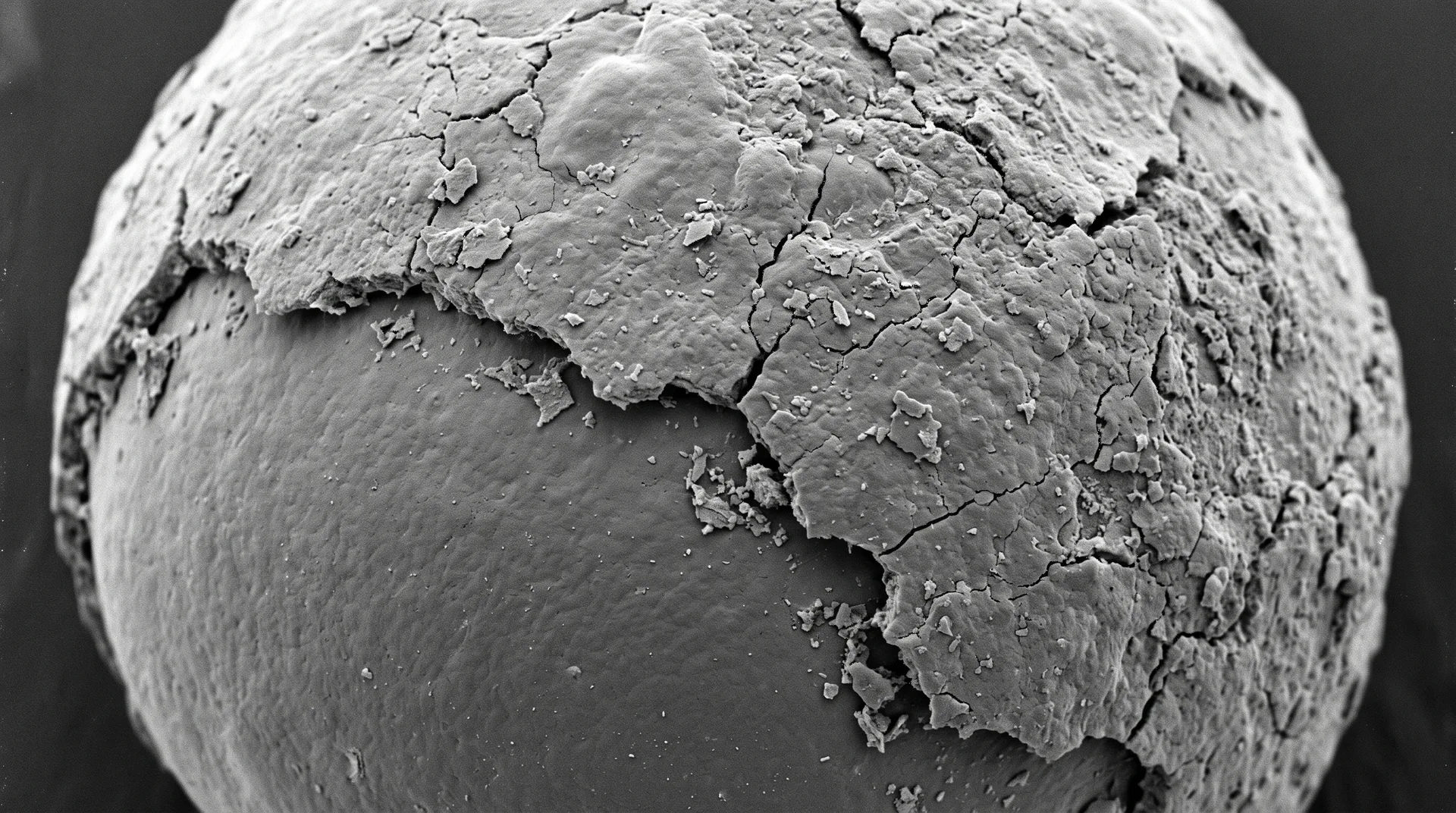
A coating is material on the outside of a grain that is not the mineral itself. A 1975 technical note identified the stain on "ginger zircon" from the Yoganup deposit in Western Australia as a cemented mixture of hydrated iron and aluminium oxides and kaolin minerals. A 1997 patent held by RGC Mineral Sands defines the iron coatings it deals with to include iron oxide and/or iron hydroxides and/or compounds of both.
The mix can vary by deposit. A Murdoch University thesis abstract reports that at Iluka's Jacinth Ambrosia ore body the contaminants include ferruginous, saline and siliceous coatings, which reduce plant recoveries and increase misreporting during separation. A 2011 conference paper notes that in some deposits valuable heavy mineral quality is poor due to increased mineral surface coatings, linked to higher slimes and more competent (harder) sand orebodies.
Coatings also matter after separation. The RGC patent says coated zircon may be unsuitable for certain end-use applications, especially where colour is a criterion.
How a coating can affect separation
The Murdoch thesis describes electrostatic separation, a process governed by the conductivity and dielectric constants of particles, as susceptible to the influence of surface contaminants, which can lead to misreporting.
Most of the studies here concern zircon. A 2012 University of Cape Town thesis, on Namakwa Sands, states that zircon coated with iron oxides reports as more conductive during electrostatic separation, which can result in a zircon particle behaving like a rutile particle. A 2006 paper by authors from Indian Rare Earths Ltd notes that high-tension separation becomes more difficult with a wide size range along with "coated non-conducting minerals".
"surface coatings present on zircon particles are unlikely the primary cause of zircon misplacement" (Bruwer, 2007, on the zircon streams examined)
Scrubbing, desliming and leaching
The 2011 paper's authors write that attrition scrubbing is the most commonly used technique to reduce surface coatings, working through mechanically induced particle to particle interaction, abrasion and shearing. The RGC patent, describing earlier practice, says that iron oxide coatings on heavy minerals may be reduced by attritioning, with or without reagents including acids.
Plant documents show where the step sits. Under a 2019 works approval application, Iluka proposed that non-magnetic concentrate from its Cataby mine be washed, attritioned and dried before entering its Narngulu mineral separation plant. A paper in the IMPC 2024 proceedings describes a flowsheet in which a stage of mechanical attrition was included to remove staining from the mineral surface, with the aim of improving selectivity through the dry circuit.
The measured scrubbing results cited here come from outside mineral sands. In a laboratory study of Egyptian glass sands, which are quartz, higher scrubber impeller speeds left less iron in the retained sand: 0.085% Fe at 1,500 rpm against 0.069% at 2,500 rpm, and the scrubbed sand was deslimed at 152 µm. Wet classification there removed a very slimy and clayey fraction. Hydrochloric acid did less: attritioning with hydrochloric acid at room temperature gave disappointing results, which the authors read as showing the iron staining is not superficial; they suggested other reagents, especially with heating, might do better.
A 2017 study of hard-rock ilmenite, not a mineral sand, measured a gain in flotation. Its feed was early tailings from the Midi concentrating mill at Panzhihua, whose grain surfaces had been seriously polluted during discharge and stockpiling, that is, contaminated. In that single laboratory study, with no replicates reported, attrition-scrubbing (25 min, 1,200 rpm, solid/liquid ratio 65%) before magnetic pre-concentration and flotation raised open-circuit ilmenite recovery from 47.64% to 55.16% (7.52 percentage points), with grade essentially unchanged (47.31% to 47.21%).
What cleaning has done in mineral-sands streams
The Murdoch thesis tested treatments on a reject stream from Iluka's Narngulu plant, rejected for high contamination. In that stream, untreated material separated poorly by electrostatics; a hydrochloric acid leach gave the largest improvement by removing iron, salt and silica contaminants. Attritioning with washing, a urea pre-treatment, and sulphuric-acid and sodium-hydroxide washes each improved separation to differing degrees; the sulphuric wash was limited by secondary mineral formation, and the caustic wash removed silicates better than iron oxides.
A process can also create its own coating. A 2005 Stellenbosch thesis found that in one plant's hot-acid-leach circuit, iron hydroxide precipitated from process water adsorbed onto zircon and rutile and impaired their electrostatic separation; after the plant changed its water treatment to remove dissolved iron, prime zircon recoveries rose.
Where the evidence points elsewhere
Most of the studies cited here were read as abstracts or publication pages, and most cover a single stream, plant or deposit. Two 2007 studies tested the coating explanation directly. Bruwer records the starting assumption, that surface coatings on zircon particles are believed to render the non-conductive zircon particles more conductive, and then finds no significant difference in the outermost layer of the zircon particles found in the different streams. Bruwer concludes that, in the streams examined, surface coatings present on zircon particles are unlikely the primary cause of zircon misplacement, and that zircon losses can possibly be a result of machine related aspects.
A companion study by Venter, Vermaak and Bruwer found that zircon from the conducting and non-conducting streams had similar resistivities, and concluded that zircon losses in the final electrostatic step appear to be due not to surface effects but to particles shielding each other. It also noted that the zircon concentrate in its study undergoes an acid treatment meant to remove impurities from the surface of both the zircon and rutile, while previous test work suggested that these impurities are not removed, but only modified. Rutile behaved differently: its resistivity changes with pH, and thus its electrostatic separation is influenced.
Measuring coating removal is itself difficult. The 2011 paper reports that elemental analysis by X-ray fluorescence (XRF) in a multi-mineral environment is unable to measure surface impurity reduction with enough precision, and that in mineralogical analysis by QEMSCAN highly coated particles are plucked out during block polishing, so the most coated grains are the hardest to count.
Related
- Metallurgy
- Processing Technology
- Ore Processing
- Refining
- Mining Methods
Sources
- PRIMARY'Technical Note on Identification and Removal of Stain from Zircon Concentrates', The AusIMM Proceedings, 1975 (authors not shown), publication page. Stain on 'ginger zircon' from the Yoganup deposit of Westralian Sands Ltd identified as a cemented mixture of hydrated iron and aluminium oxides and kaolin minerals.
- PRIMARYUS Patent 5,637,281 A, RGC Mineral Sands Ltd, granted 10 June 1997 (printed title garbled; on the removal of iron oxide coatings from zirconiferous material). A producer's patent: definition of iron coatings; prior-art reduction of iron oxide coatings by attritioning, with or without reagents; coated zircon unsuitable where colour is a criterion.
- PRIMARYKilleen, D., 'The effect of surface contamination on the electrostatic separation of mineral sands', Masters by Research thesis, Murdoch University, research portal record (abstract; full text embargoed to 1 November 2026). Electrostatic separation and surface contaminants; coatings at Iluka's Jacinth Ambrosia ore body; laboratory treatments of a reject stream from Iluka's Narngulu mineral separation plant.
- PRIMARYMaluleke, O.S. and Grobler, J.D., 'Attritioner scrubber performance evaluation', Proceedings of the Eighth International Heavy Minerals Conference 2011, AusIMM, pp. 185–196, abstract. Coatings in some deposits; attrition scrubbing as the most commonly used technique; limits of XRF and QEMSCAN in measuring coating removal.
- PRIMARYLedgerwood, J.P., 'Reaction phenomena of iron oxide leaching in an evaporative acid bake reactor', MSc thesis, University of Cape Town, 2012, abstract. Zircon coated with iron oxides reporting as more conductive during electrostatic separation.
- PRIMARYBruwer, J.G., 'Zircon Surface Characterization', SAIMM, 2007, 3 pp., abstract. The hypothesis that coatings make zircon more conductive; no significant difference in the outermost layer of zircon from different streams; coatings unlikely the primary cause of zircon misplacement; machine-related aspects as a possible cause.
- PRIMARYVenter, J.A., Vermaak, M.K.G. and Bruwer, J.G., 'Influence of Surface Effects on the Electrostatic Separation of Zircon and Rutile', SAIMM, 2007, 6 pp., abstract. Acid treatment of zircon concentrate; earlier test work suggesting impurities are modified rather than removed; similar resistivities of zircon from conducting and non-conducting streams; shielding of particles; rutile resistivity changing with pH.
- PRIMARYPrinsloo, A., 'The formation of chemical precipitates in the HAL process and its impact on electrostatic separation of zircon and rutile minerals', MScEng thesis, Stellenbosch University, 2005, abstract. Iron hydroxide precipitated from process water adsorbing onto zircon and rutile in a hot-acid-leach circuit; prime zircon recoveries after the plant changed its water treatment.
- PRIMARYKumar, C.R., Daniel, F., Murty, V.S. and Kumar, S.S. (Indian Rare Earths Ltd), 'Effect of Process Variables on High-Tension Separation: A Statistical Approach', Proceedings of the International Seminar on Mineral Processing Technology, Chennai, 2006, p. 559: separation more difficult with a wide size range along with coated non-conducting minerals.
- PRIMARYDepartment of Water and Environmental Regulation, Western Australia, 'Works Approval W6215/2019/1: Decision Report', Iluka Resources Ltd, Narngulu Mineral Separation Plant, 14 March 2019. p. 1: Cataby non-magnetic heavy-mineral concentrate to be washed, attritioned, dried and stored in the Plant 1 feed bins.
- PRIMARYXXXI International Mineral Processing Congress 2024 Proceedings, SME, p. 1214 (excerpt; paper title and authors not shown on the page). A stage of mechanical attrition included to remove staining, with the aim of improving selectivity through the dry circuit.
- PRIMARYYousef, A.A., Boulos, T.R. and Saada, M.Y., 'Beneficiation of some Egyptian glass sands', National Research Centre, Cairo, pp. 231–237 (journal and year not shown in the document). Quartz glass sand, not heavy minerals. p. 231: laboratory scrubbing and desliming at 152 µm. p. 232: wet classification removing a slimy, clayey fraction; Table IV, Fe in the −1.003+0.152 mm fraction at 1,500, 2,000 and 2,500 rpm. pp. 233–234: hydrochloric acid attritioning at room temperature; other reagents, especially on heating, suggested.
- PRIMARYZhai, J., Chen, P., Wang, H., Hu, Y. and Sun, W., 'Flotability Improvement of Ilmenite Using Attrition-Scrubbing as a Pretreatment Method', Minerals 7(1), 13, 2017. Hard-rock ilmenite: early tailings of the Midi concentrating mill, Panzhihua. §2.2: surface pollution during discharge and stockpiling. §2.3: scrubbing conditions. §3.2.2 and Tables 7–8: open-circuit flotation grade and recovery with and without scrubbing.
- ANALYSISANALYSIS: the reading that the published record on coatings in mineral sands is made up mostly of single streams, single deposits and conference abstracts, so that it shows coatings can matter in particular cases without showing how much they matter in general. This publication's assessment of the studies cited here.Non-public document · no public URL