Minerals Hub / Mining & Production / Flotation makes the chosen mineral repel water
Mining & Production · Monazite · 5 min read
Flotation makes the chosen mineral repel water
Reagents make one mineral's surface repel water so that bubbles can lift it away, a method that a 2024 congress paper says has seen limited use in mineral sands.
Reviewed by Peter Uppal
The short version
In flotation, reagents called collectors make the chosen mineral's surface water-repellent, so its particles attach to air bubbles and rise into a froth that overflows the cell; the chosen mineral can be an unwanted one, as in a 2019 proposal to float barite away from zircon. A 2025 review says flotation is quite effective for particles usually between about 25 and 100 µm, and that its performance falls significantly outside that band. In mineral sands, a paper in the IMPC 2024 proceedings says flotation has been used to upgrade titania, zirconia and rare-earth minerals but has seen limited use in the industry since dry electrostatic and magnetic separators improved.
A separation by surface
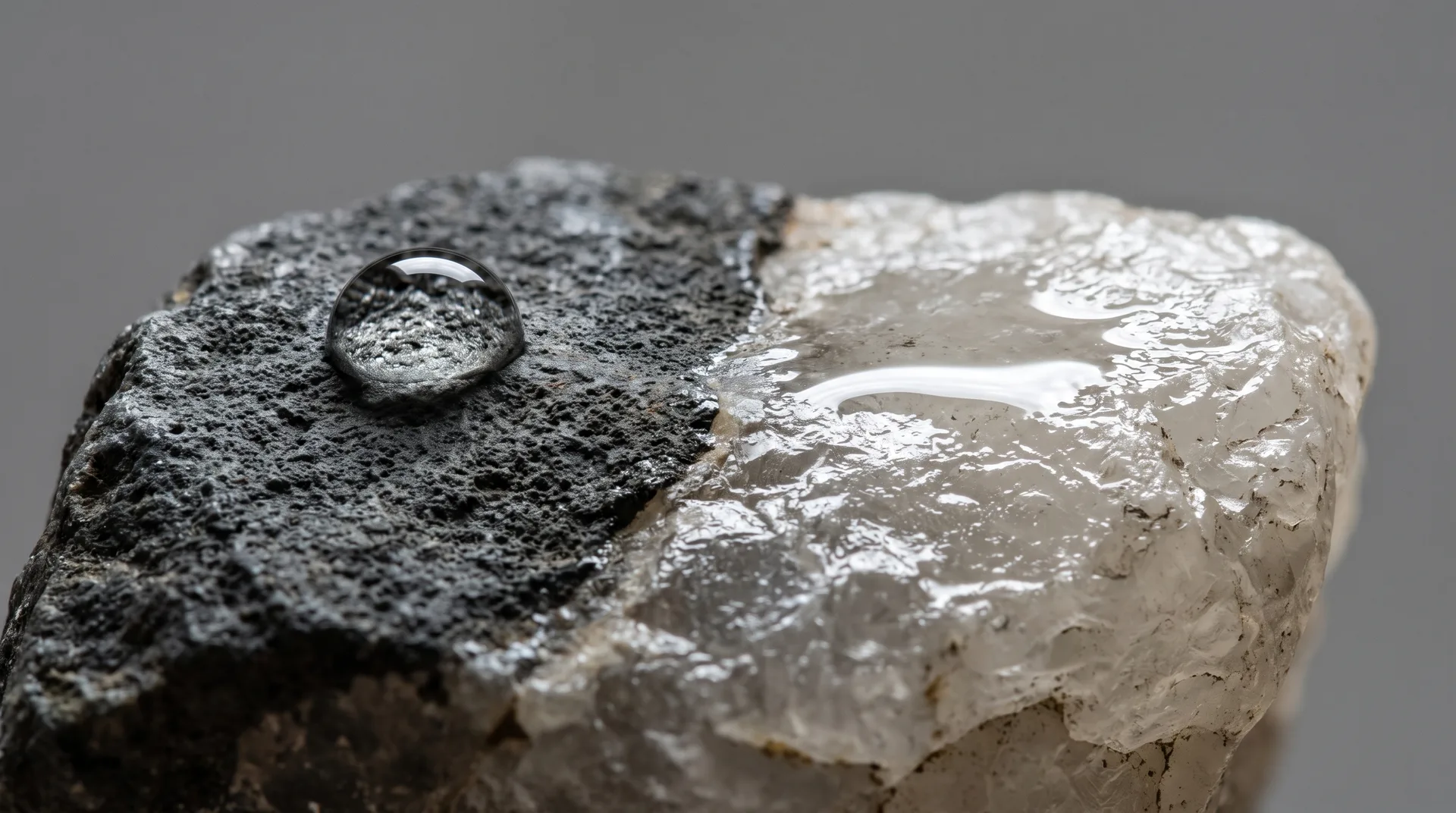
A 2005 University of Cape Town thesis describes flotation as a process that separates valuable minerals from the undesired gangue components of an ore "by exploiting differences in their hydrophobicity": gangue being the unwanted minerals, and hydrophobicity how strongly a surface repels water.
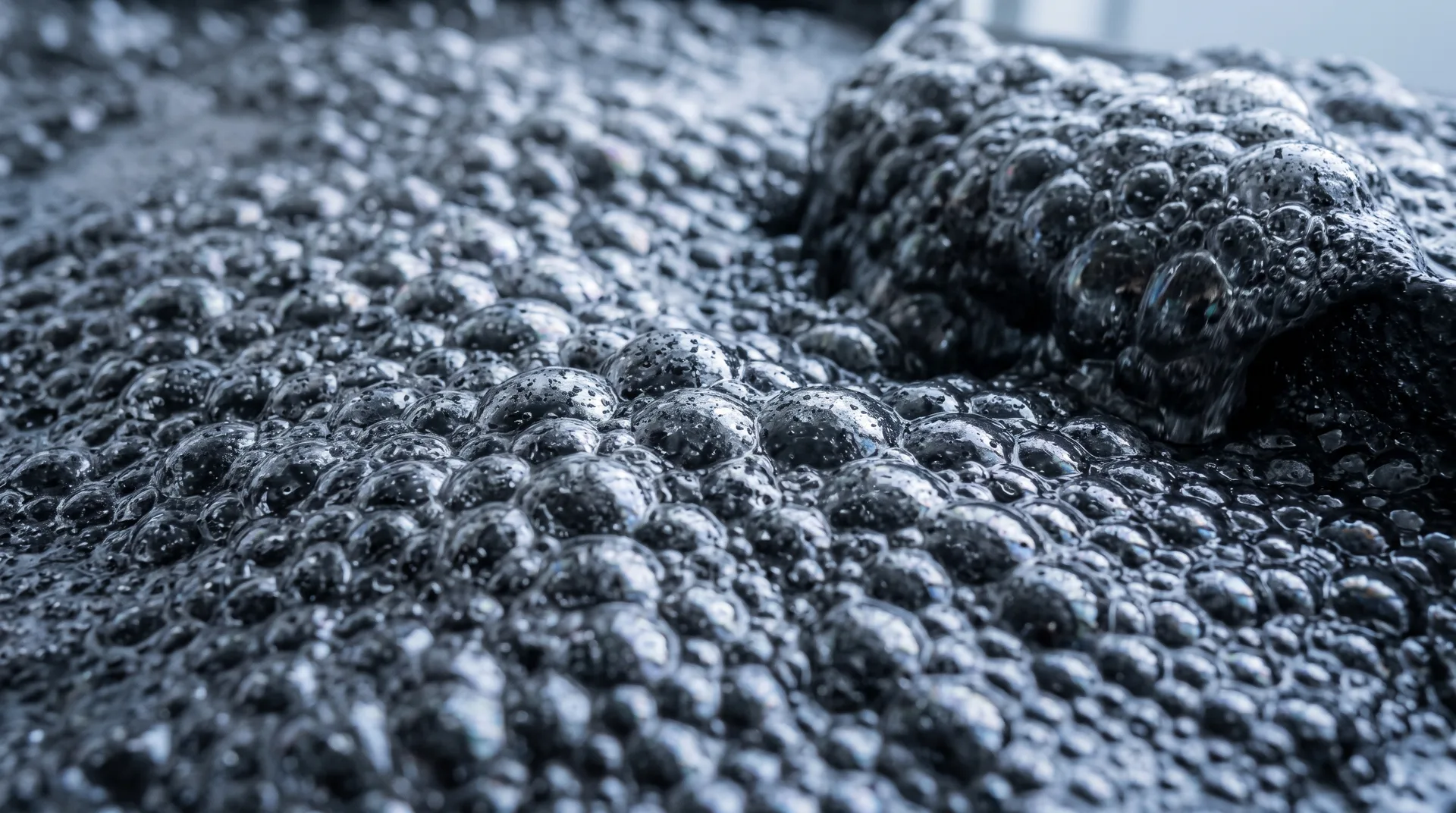
The mechanics follow from that. A 2025 review describes air bubbles and mineral particles aggregating in water, the aggregates floating to the surface and passing into a froth layer. A 2021 study of monazite surfaces says that floating minerals have a more hydrophobic surface, which makes them easier to attach to bubbles.
The reagents steer which mineral floats
The Cape Town thesis states that the surfaces of the valuable minerals are made hydrophobic by reagents called collectors. The 2025 review sets out the rest of the kit in one sentence: collectors increase hydrophobicity, frothers ensure froth stability, depressants suppress gangue attachment, and modifiers regulate how collectors interact with individual minerals.
Frothers matter because they are needed for the formation of stable froths and effective collection and recovery. Depressants work the other way round: they are used to increase the selectivity of flotation by adsorbing onto hydrophobic gangue particles, rendering them hydrophilic. The thesis also names activators among the other reagents added to facilitate the process, alongside frothers and modifiers.
"Depressants are used to increase the selectivity of flotation..." (Dhliwayo, University of Cape Town, 2005)
Inside the cell
A 2025 comparison of two laboratory cell designs states that hydrodynamics within the flotation system are primarily influenced by the impeller, and in both designs air is sheared into bubbles as it is introduced near the impeller.
Tshazi, Leal Filho and Naude describe the route a floated particle has to take. A particle needs to collide with an air bubble, the two must attach, and the unit must remain stable as it rises into the froth zone until it is discharged via the cell lip. There is also a second route. In entrainment, particles are not attached to bubbles but are carried upward by the flow of water or by the wake, and the paper calls that mechanism non-selective.
Where fine becomes too fine
The authors of a 2024 study of an Indian coastal placer write that it is a known fact and industrially accepted that flotation is a process for fine-particle separation. Other sources set the size limits. The 2025 review says that for a small range of particle sizes, usually −100 +25 µm, flotation separation is quite effective, and that performance reduces significantly while processing ultrafine (below about 25 µm) and coarse (above about 100 µm) particles. Fine particles have a high surface-area-to-volume ratio, which can reduce their hydrophobicity, and they tend to agglomerate into clumps that may not attach well to bubbles. Below about 10 µm, according to the Cape Town thesis summarising Subrahmanyam and Forssberg (1988), collision efficiency between particles and bubbles is low and fine particles are collected mainly by entrainment, the non-selective route.
On this publication's reading, flotation helps with particles that are fine, but not with whatever is finest.
Monazite and xenotime
Raffaillac and MacHunter of Mineral Technologies note that monazite and xenotime are frequently found in detrital heavy mineral sand resources, and in a 2024 paper they compare froth flotation in parallel with conventional dry separation for secondary upgrade circuits. A 2015 review covers monazite and xenotime separation by flotation, including how collectors and depressants interact with these mineral surfaces.
At the Bramhagiri placer in Odisha, the 2024 study found that monazite grains were finer than the other valuable minerals, and that magnetic separation alone did not produce the desired grade of monazite, so the authors floated the magnetic product of their magnetic separation step. In batch tests in a Denver-type laboratory flotation cell at pH 9, the 2024 study used oleic acid as the collector, pine oil as the frother and sodium silicate to depress quartz. The 2024 study's floatability table, with oleic acid at pH 9, rates monazite "Floatable" and zircon, rutile, ilmenite and garnet "Not-Floatable". The paper also notes that fine-grained monazite flotation has been investigated with special reagents to stop other minerals floating with it, citing a body of earlier studies.
The 2021 monazite study states that oleic acid has long been the main collector of flotation of rare earth minerals, and that hydroxamate is the significant alternative collector for monazite flotation. Its authors call flotation the most effective way to concentrate monazite from related gangue minerals, writing about mixed light rare-earth ores in northern China rather than about mineral sands.
A 1993 congress paper explored the possibility of using flotation to separate monazite from xenotime, a split said to be difficult with generally used physical beneficiation methods. It found monazite floatability governed by electrostatic interaction with the collector, with a marked drop for one sample of low crystallinity and a rugged, complex surface.
A minor tool in mineral sands
A page of the IMPC 2024 proceedings, from a paper whose authors are not shown there, takes the industry as a whole. It says flotation has been used to upgrade titania, zirconia and rare-earth minerals, but has seen limited use in the mineral sands industry since dry electrostatic and magnetic separators improved; it has been considered competitive with, rather than complementary to, gravity, magnetic and electrostatic separation.
Uses do exist outside the rare earths. In 2019, Iluka sought approval to build a flotation circuit at its Narngulu mineral separation plant in Western Australia to remove naturally occurring barite from zircon in Cataby concentrate, designed, in the regulator's words, to exploit the differences in surface chemistry of barite and zircon. In that proposed design, the circuit would "bind and remove (i.e. float) the barite from the zircon".
Related
- Metallurgy
- Processing Technology
- Ore Processing
- Refining
- Exploration
Sources
- PRIMARYSigauke, T., Johnson, O.T., Ndeshimona, V.L. and Mashingaidze, M.M., 'Advancements in nanotechnology for the enhanced flotation of fine mineral particles: a review', Discover Applied Sciences 7(4), 317, 2025. §1: bubble–particle aggregation and the froth layer; roles of collectors, frothers, depressants and modifiers. §2: effective size range (usually −100 +25 µm, citing its ref. 22); reduced performance for ultrafine and coarse particles; surface area, hydrophobicity and agglomeration of fine particles.
- PRIMARYDhliwayo (Masaso), E.C., 'The interactive effect of depressant type and dosage with frother dosage in the flotation of a PGE ore', MSc(Eng) thesis, University of Cape Town, April 2005. §2.1, p. 5: flotation exploiting differences in hydrophobicity; collectors; other reagents (frothers, activators, modifiers). §2.1.1, p. 7: frothers. §2.1.2, p. 9: depressants.
- SECONDARYDhliwayo (Masaso), E.C., MSc(Eng) thesis, University of Cape Town, 2005, §2.2.3, p. 19, summarising Subrahmanyam and Forssberg (1988): below 10 µm, low collision efficiency and collection by entrainment. A thesis reporting another work, so tagged SECONDARY.
- PRIMARYTshazi, M.P., Leal Filho, L.S. and Naude, N., 'Comparison of Denver and Leeds laboratory flotation cells: Effect of particle size and hydrodynamics', Journal of the Southern African Institute of Mining and Metallurgy 125(5), 225–232, 2025. pp. 226–227: true flotation and entrainment; air sheared at the impeller in two laboratory cell designs; hydrodynamics primarily influenced by the impeller.
- PRIMARYSingh, D. and others, 'Development of Process Flow Sheet for Recovering Strategic Mineral Monazite from a Lean-Grade Bramhagiri Coastal Placer Deposit, Odisha, India', Minerals 14(2), 139, 2024. §1: earlier investigations of fine-grained monazite flotation. §2: batch flotation in a Denver laboratory cell at pH 9 with oleic acid, pine oil and sodium silicate. Table 1: floatability with oleic acid at pH 9. §3.4: monazite finer than other valuable minerals; magnetic separation alone not giving the desired grade. §3.5: flotation as an industrially accepted fine-particle process.
- PRIMARYZheng, Q. and others, 'Surface Mechanism of Fe³⁺ Ions on the Improvement of Fine Monazite Flotation With Octyl Hydroxamate as the Collector', Frontiers in Chemistry 9, 700347, 2021. Introduction: oleic acid as the long-standing main collector for rare-earth minerals; hydroxamate as an alternative for monazite; flotation as the most effective way to concentrate monazite from gangue, in the context of mixed light rare-earth resources in northern China. Results: hydrophobic surfaces attach more easily to bubbles.
- PRIMARYChehreh Chelgani, S., Rudolph, M., Leistner, T., Gutzmer, J. and Peuker, U.A., 'A review of rare earth minerals flotation: Monazite and Xenotime', International Journal of Mining Science and Technology 25(6), 877–883, 2015, abstract (HZDR publication record).
- PRIMARY'A Flotation Study for Effective Separation of the Heavy Mineral Sands', XVIII International Mineral Processing Congress, AusIMM, 1993 (authors not shown), abstract. Flotation proposed for separating monazite from xenotime; floatability governed by electrostatic interaction with the collector; a marked drop for one low-crystallinity sample.
- PRIMARYRaffaillac, E. and MacHunter, R. (Mineral Technologies), 'Flowsheet Development of Two Distinct Rare Earth Minerals Bearing Heavy Mineral Sand Ores', XXXI IMPC 2024 Proceedings, SME, p. 1208. Authors from an equipment maker: monazite and xenotime frequently found in detrital heavy-mineral-sand resources; froth flotation compared with dry separation for secondary upgrade circuits.
- PRIMARYXXXI International Mineral Processing Congress 2024 Proceedings, SME, excerpt (paper title and authors not shown on the page; running header ending 1215). Flotation's use to upgrade titania, zirconia and rare-earth minerals, and its limited use in the mineral sands industry.
- PRIMARYDepartment of Water and Environmental Regulation, Western Australia, 'Works Approval W6215/2019/1: Decision Report', Iluka Resources Ltd, Narngulu Mineral Separation Plant, 14 March 2019. p. 1: proposed barite removal circuit, comprising a flotation circuit, for Cataby non-magnetic heavy-mineral concentrate, to bind and remove (float) the barite from the zircon.
- ANALYSISANALYSIS: the reading that flotation's effective size band and the finer end of a heavy-mineral feed only partly overlap, so flotation is not simply the answer for whatever is too fine for other methods. This publication's framing of the size sources cited here.Non-public document · no public URL