Minerals Hub / Mining & Production / How a charged roll splits conductors from non-conductors
Mining & Production · Rutile · 5 min read
How a charged roll splits conductors from non-conductors
A high-tension separator charges every grain and then lets the conductors give their charge away, which sends grains that behave as conductors (rutile, ilmenite) one way and non-conductors (zircon, monazite) another.
Reviewed by Peter Uppal
The short version
Under a high voltage, ilmenite, rutile and leucoxene behave as conductors and zircon, garnet and monazite as non-conductors, according to a 2006 paper by authors from Indian Rare Earths Ltd. A high-tension separator uses that difference on an earthed, rotating roll: conducting grains lose their charge to the roll and are thrown clear, while non-conducting grains stay charged, cling to it and are removed further round. The 2006 IREL paper states that effective separation needs dry, closely sized feed, and that several stages are needed to make high-purity products with good recovery.
Conductors and non-conductors
Conductivity here means whether a grain lets an electric charge move through it and away, or holds on to it. The 2006 IREL paper sorts the mineral-sands suite on that basis: ilmenite, rutile and leucoxene "behave as conducting minerals", while zircon, sillimanite, garnet and monazite "behave as non-conducting minerals when high potential difference is applied".
Among some non-conductors the differences are small. A paper in the IMPC 2024 proceedings describes aluminosilicates, zircon and monazite as non-conductive minerals "with modest difference in electrostatic response". On this publication's reading, that makes those non-conductors hard to split from one another on a high-tension roll, which leaves parting zircon from monazite to other steps (see Magnetic separation matches field strength to the mineral).
How the roll works
The IREL paper sets out the sequence. High voltage ionises the air between the electrodes, and the ions charge the feed; a corona discharge occurs once the potential difference between two electrodes is raised to a sufficient level. The separator then uses a grounded roll to neutralise the charge of the feed material.
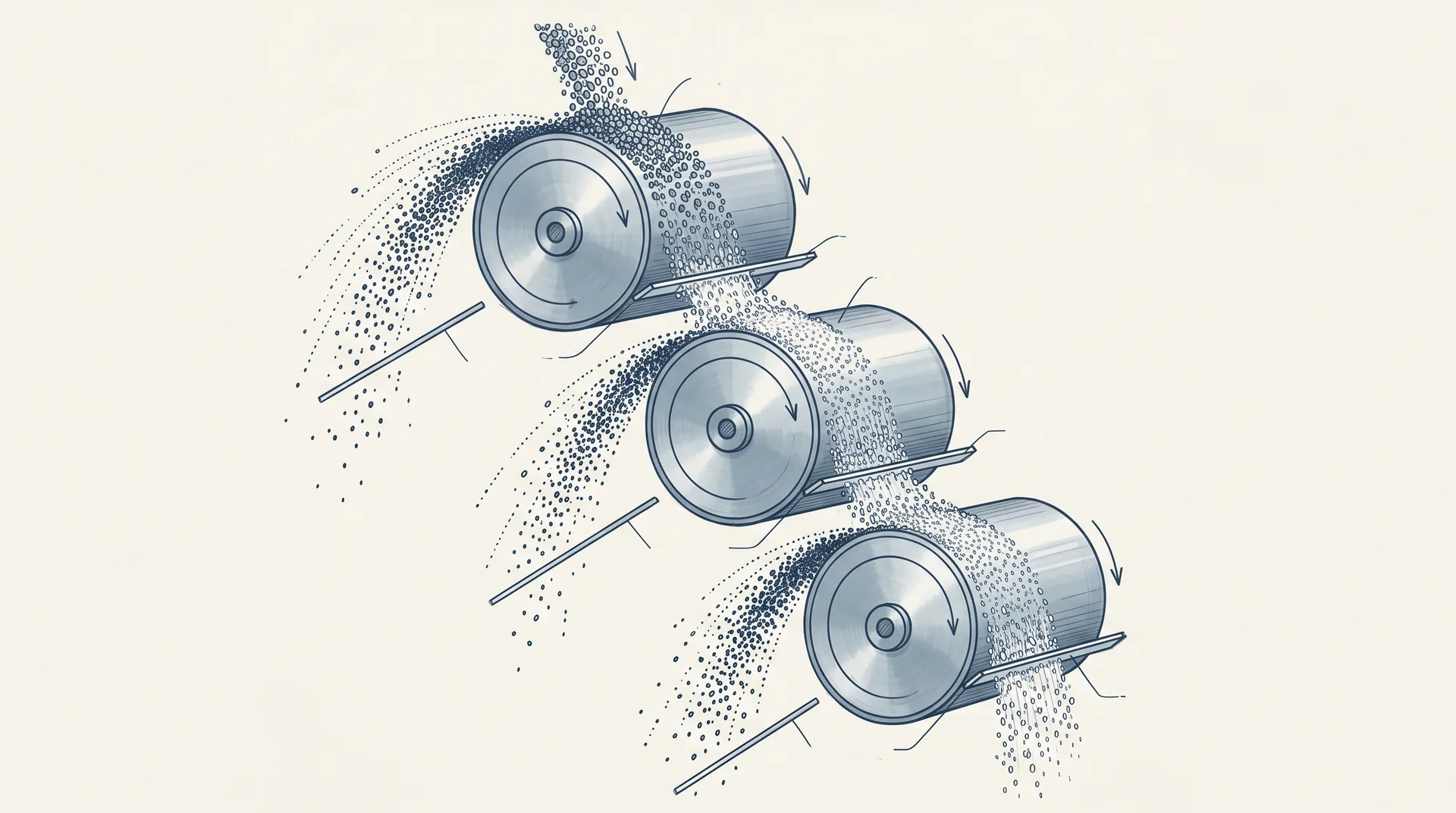
That is where the grains part company. The conducting particles lose their charge to the grounded roll. Premaratne and Rowson, describing their 2004 laboratory work, report that conductive particles lost their charge on an earthed rotor surface and were thrown clear by the rotation. The non-conductors behave differently. They are pinned to the roll, carried further round and removed by mechanical means such as a brush or a high-voltage AC wiper. In the 2004 study, the non-conductive charged particles were held on the rotor surface and discharged via a brush.
Where a conductor lands depends on the machine as well as the mineral: the conducting particle's trajectory off the rotor is influenced mainly by rotor speed.
Rolls are one geometry among several. The IREL paper notes that electrostatic separators are available in plate and screen electrode types, mainly used to clean a small quantity of conducting particles out of a large quantity of non-conductors. Mineral Technologies, an equipment maker, offers high tension roll, electrostatic plate, electrostatic screen and tribostatic separators, the last charging particles by friction, in the maker's description.
Why the feed is dried, and why heat matters
The IREL paper states that effective electrostatic separation requires "moisture free closed sized particles". Mineral Technologies describes its electrostatic separators as for dry, free-flowing materials of 40 to 800 µm. Moisture also changes the electrical conditions: presence of humidity has a significant effect on the corona, and the corona inception voltage, at which the corona starts, decreases with increasing humidity.
Roll speed comes first in the IREL results. In its laboratory trials, run on feed at 100, 120 and 140 °C, roll speed had by far the largest effect on yield and grade; temperature influenced recovery more than feed rate did.
Heat still matters. The Kerala Minerals and Metals Ltd, in India, says it uses a fluidised-bed dryer to remove moisture and keep the sand at 100 °C. A 1991 AusIMM conference abstract reported that, in commercial operations, conditions in the drier were found to "have a considerable effect on the subsequent electrostatic separation" of rutile and zircon. In the 1991 laboratory work, rutile's conductivity "varies markedly with treatment temperature, time and gas composition", while the zircon "is unaffected". Raising rutile's conductivity can give significant gains in separation efficiency, the 1991 laboratory study reported.
One roll is rarely the whole job
The IREL paper says that several stages are needed to make high-purity products with good recovery. Mineral Technologies supplies its roll separator with two or three roll stages for non-conductor cleaning, conductor cleaning, or middlings re-treatment, middlings being material that belongs clearly to neither product, and its plate and screen units with five stages re-treating the non-conductors.
"...stages of such operations are necessary to produce high pure mineral products with good recovery." (Indian Rare Earths Ltd authors, 2006)
Where the roll sits in a plant also varies. KMML says its dry mill first separates concentrate into conducting and non-conducting fractions by using high-tension electrostatic separators, and that its zircon concentrate is fed through a series of high-tension electrostatic and magnetic separators. Kenmare describes the reverse order at its Moma mine: the magnetic fraction of WHIMS output is dried and processed electrostatically to make ilmenite products, while on the non-magnetic side of the WHIMS step electrostatic separators separate the conducting mineral rutile from the nonconducting minerals zircon and monazite. At Sri Lanka's Pulmoddai plant, as Premaratne and Rowson describe it in 2004, the non-magnetic concentrate is dried and passed through electrostatic separators to separate rutile from zircon.
Surface coatings
A 2012 University of Cape Town thesis, on Namakwa Sands, states that zircon coated with iron oxides reports as more conductive during electrostatic separation. Two 2007 studies of zircon streams point elsewhere: one found surface coatings unlikely the primary cause of zircon misplacement in the streams it examined, and the other concluded that zircon losses in the final electrostatic step appear to be due not to surface effects but to particles shielding each other (see When cleaning the grains improves separation).
Related
- Processing Technology
- Ore Processing
- Metallurgy
- Refining
- Exploration
Sources
- PRIMARYKumar, C.R., Daniel, F., Murty, V.S. and Kumar, S.S. (Indian Rare Earths Ltd), 'Effect of Process Variables on High-Tension Separation: A Statistical Approach', Proceedings of the International Seminar on Mineral Processing Technology, Chennai, 2006, pp. 559–563. p. 559: conducting and non-conducting minerals under high potential difference; ionised air and corona discharge; moisture-free, closely sized feed; several stages needed; coated non-conducting minerals. p. 560: grounded roll; plate and screen electrode types; humidity and corona inception voltage; 27 laboratory experiments on an MDL high-tension separator (Table 1: 100, 120 and 140 °C). p. 562: trajectory mainly influenced by rotor speed; ANOVA order of significance. p. 563: conclusion on temperature and feed rate.
- PRIMARYPremaratne, W.A.P.J. and Rowson, N.A., 'Recovery of titanium from beach sand by physical separation', European Journal of Mineral Processing and Environmental Protection 4(3), 183–193, 2004 (copy hosted at 911metallurgist.com). §2.3, p. 185: conductive particles losing their charge on an earthed rotor and thrown clear; non-conductive particles held on the rotor and discharged via a brush.
- SECONDARYPremaratne, W.A.P.J. and Rowson, N.A., 2004, Introduction, p. 183: practice at the Pulmoddai mineral separation plant, Sri Lanka, citing Lanka Mineral Sand Ltd (1999). Authors describing plant practice from another work, so tagged SECONDARY.
- PRIMARYMineral Technologies (CPG Resources), 'Leaders in Mineral Separation: Electrostatic Separators' (Carrara range), product brochure, undated. Equipment maker's own material: high-tension roll, plate, screen and tribostatic separators; dry, free-flowing feed of 40 to 800 microns; two or three roll stages; five plate and screen stages re-treating non-conductors.
- PRIMARYKenmare Resources plc, 'Moma's operating process', company web page (published 24 September 2024, modified 15 May 2026). Producer's own description: electrostatic separation of conducting rutile from non-conducting zircon and monazite; WHIMS magnetic fraction dried and processed electrostatically to ilmenite products.
- PRIMARYThe Kerala Minerals and Metals Ltd (KMML), 'Manufacturing Facility: Mineral Separation Unit', company web page, undated. Producer's own description: fluidised-bed dryer holding sand at 100 °C; dry mill splitting concentrate into conducting and non-conducting fractions with high-tension separators; zircon concentrate fed through a series of high-tension electrostatic and magnetic separators.
- PRIMARY'The Effects of Thermal Pre-Treatment on the Electrical Conductivities of Rutile and Zircon', Fifth AusIMM Extractive Metallurgy Conference, Perth, October 1991 (authors not shown), abstract. Drier conditions and subsequent electrostatic separation; laboratory-scale results on rutile and zircon conductivity.
- PRIMARYXXXI International Mineral Processing Congress 2024 Proceedings, SME, p. 1214 (excerpt; paper title and authors not shown on the page). Aluminosilicates, zircon and monazite as non-conductive minerals with modest difference in electrostatic response.
- PRIMARYLedgerwood, J.P., 'Reaction phenomena of iron oxide leaching in an evaporative acid bake reactor', MSc thesis, University of Cape Town, 2012, abstract. Zircon coated with iron oxides reporting as more conductive during electrostatic separation.
- PRIMARYBruwer, J.G., 'Zircon Surface Characterization', SAIMM, 2007, 3 pp., abstract. Surface coatings on zircon unlikely the primary cause of zircon misplacement in the streams examined.
- PRIMARYVenter, J.A., Vermaak, M.K.G. and Bruwer, J.G., 'Influence of Surface Effects on the Electrostatic Separation of Zircon and Rutile', SAIMM, 2007, 6 pp., abstract. Zircon losses in the final electrostatic separation appearing to be due to shielding of particles rather than surface effects.
- ANALYSISANALYSIS: the reading that a modest difference in electrostatic response among non-conductors makes them hard to separate from one another on a high-tension roll. This publication's framing of the IMPC 2024 excerpt.Non-public document · no public URL