Minerals Hub / Mining & Production / Why ore is crushed and ground in stages
Mining & Production · 5 min read
Why ore is crushed and ground in stages
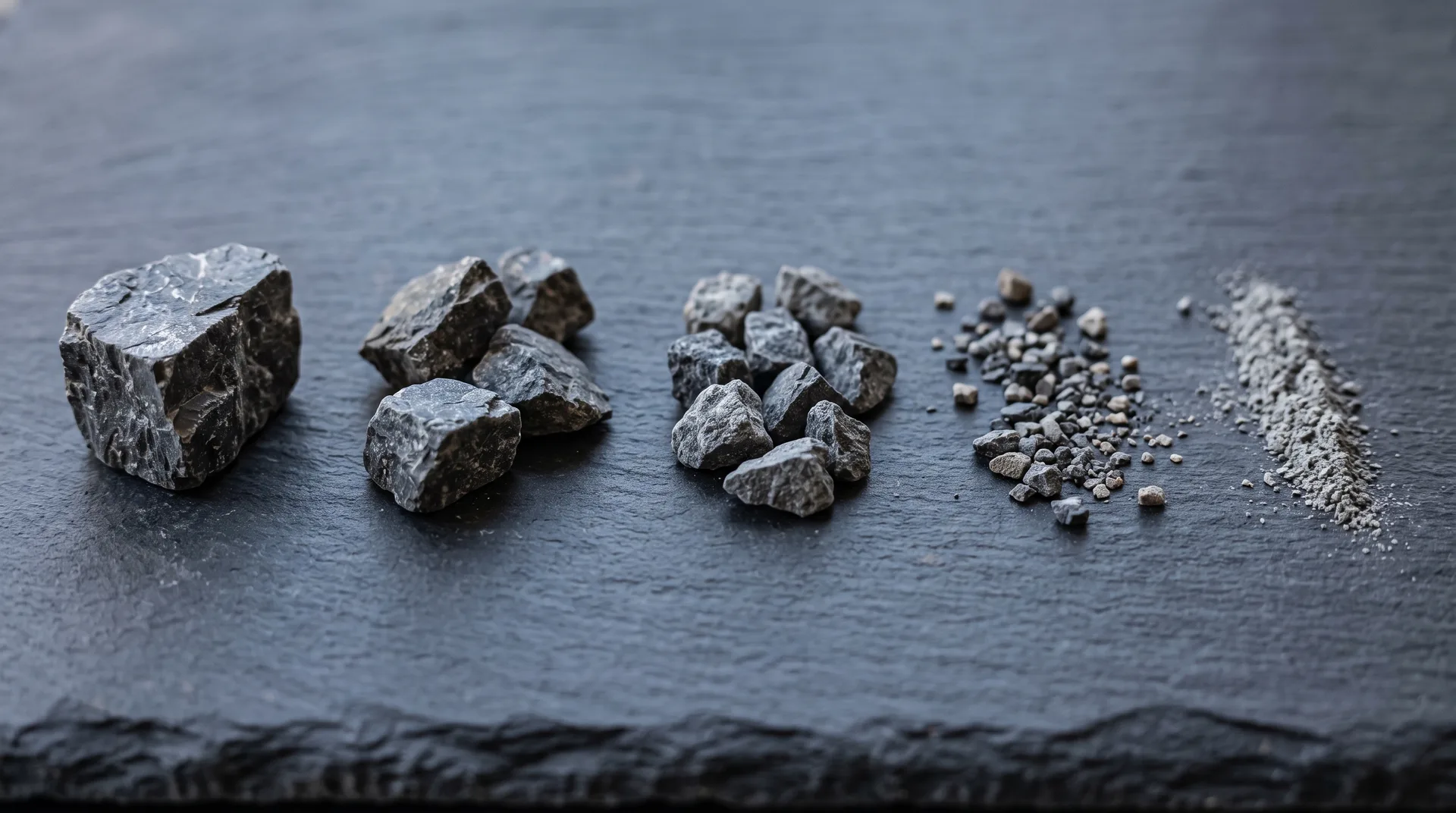
No single machine takes hard rock from boulder to fine powder, so hard ore passes through a sequence of crushers and mills, each built for one band of sizes.
Reviewed by Peter Uppal
The short version
Hard ore is broken down in steps because, as Metso's equipment handbook (Basics in Minerals Processing, Edition 8, 2011) puts it, all crushers have a limited reduction ratio meaning that size reduction will take place in stages. Metso's 2011 handbook says that for further reduction, say below 5–20 mm, grinding has to take over from crushing, and that grinding is staged too. Coastal heavy-mineral sands, which USGS describes as typically well sorted, medium- to fine-grained, well-rounded, and not indurated, usually need little of this; cemented ore is the exception.
Most mineral sands arrive already broken
The US EPA's description of metallic minerals processing states that the number of crushing steps necessary to reduce ore to the proper size vary with the type of ore. In that 1982 text, hard ores, including some copper, gold, iron, and molybdenum ores, may require as much as a tertiary crushing, while softer ores, such as some uranium, bauxite, and titanium/zirconium ores, require little or no crushing.
The USGS deposit model says that heavy-mineral sand deposits are generally easy to excavate, which spares costs associated with blasting, rock crushing, and grinding. Metso's 2011 handbook groups beach sands with the cases where minerals are freed by natural size reduction rather than by grinding.
At South Africa's Namakwa Sands, a 2011 paper describes cemented hard layers that effectively lithify the mineralised sands to various degrees of hardness, rendering that ore unsuitable for routine treatment by wet spirals. A 2008 paper on the mine reported that younger duricrust layers cement a significant part of the generally unconsolidated ore, and that the plant of the time was not geared to treat hard ore. The 2011 authors report an expansion that added a SAG mill and screen to treat the cemented layers, which the authors describe as the first in the mineral sands industry, and that contained zircon output rose after the expansion, at the cost of marginally lower recoveries, as pilot studies had predicted.
Reduction ratios set the number of stages
Every crusher can reduce a lump by only so much. Metso's 2011 handbook gives typical reduction ratios (feed size divided by product size) of 3–4 for jaw and gyratory crushers, 4–5 for cone crushers, 10–15 for horizontal impactors and 3–8 for vertical impactors.
How many stages a circuit needs depends on the ore and the mill waiting downstream. Metso's 2011 handbook describes “classical” 3-stage crushing prior to rod mill as one arrangement, and typical 1–2 stage ore crushing prior to AG-SAG mill as another. Metso adds that for ore, crushing is normally of limited importance besides the top size of the product going to grinding, so the number of crushing stages can be reduced, depending on the feed size the primary grinding stage accepts.
The crushing stages
A stage-by-stage description comes from US EPA's account of crushed-stone plants, written in 2004 for aggregate rather than ore. In crushed-stone plants, jaw, impactor, or gyratory crushers are usually used for initial reduction, with product normally 7.5–30 cm across (75–300 mm). In crushed-stone plants, cone crushers are commonly used for secondary crushing (although impact crushers are sometimes used), which typically reduces material to about 2.5–10 cm (about 25–100 mm). In crushed-stone plants, tertiary crushing is usually performed using cone crushers or other types of impactor crushers, with output typically about 0.5–2.5 cm (about 5–25 mm).
Screens sit between the crushers and decide which material needs the next one. In EPA's description, material that falls through the second level of the screen, one of its stacked screening decks, bypasses the secondary crusher because it is sufficiently small for the last crushing step, while oversize material from the top deck of the sizing screen is fed to the tertiary crusher. For metallic ores, EPA says a single crushing operation likely includes a hopper or ore dump, screens, crusher, surge bin, apron feeder, and conveyor belt transfer points.
Which crusher goes first depends on the rock. Metso's 2011 handbook advises a horizontal impactor as the usual first choice for soft feed below Mohs hardness 5, and for harder feed a jaw crusher where possible, moving to a gyratory only at very high capacities. Metso also notes that the cone crusher is frequently used as the secondary stage in ore and mineral circuits.
An extra crushing stage is sometimes added ahead of the mills. A 2024 mill operators' conference paper describes secondary crushing as a means to debottleneck the AG/SAG mills when processing coarse-competent feed.
The grinding stages
Grinding takes over where crushing stops. US EPA's 1982 text says that final comminution of both hard and soft ores is often accomplished by grinding operations using media such as balls or rods, and that grinding is most often performed with an ore/water slurry.
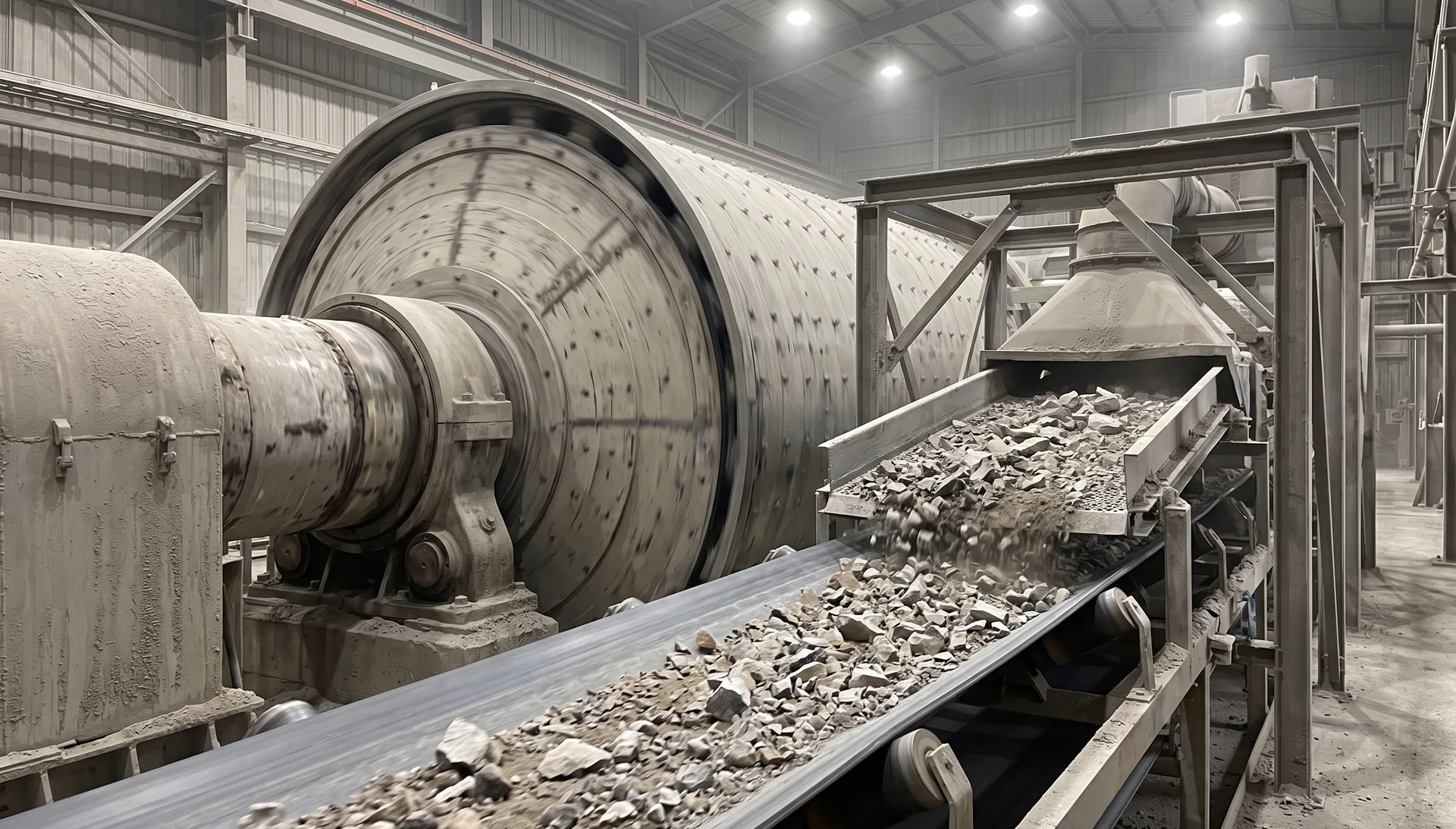
In Metso's 2011 handbook, an autogenous (AG) mill handles primary, coarse grinding up to 400 mm feed size, and in it the grinding media is grinding feed. In Metso's 2011 handbook, a semi-autogenous (SAG) mill uses grinding feed plus a ball charge, with balls 100–125 mm in diameter. Glencore Technology, which makes a rival stirred mill, writes that tumbling mills such as SAG Mills are still the go-to for coarse primary grinding.
Metso's 2011 handbook charts the theoretical size range of each mill: AG and SAG mills from 400 mm feed to 75 µm, rod mills from 50 mm to 600 µm, and ball mills from 15 mm to 20 µm. Stirred media mills, which a 2023 peer-reviewed study by Can and Altun calls indispensable members of the mineral processing flowsheets, work at the fine end of that scale: Metso's 2011 chart gives them a theoretical range of 100 µm to 2 µm.
"In practise also size reduction by grinding is done in optimised stages." Metso, Basics in Minerals Processing, Edition 8 (2011)
Why the sequence stops where it does
The point of all this is liberation. Metso's 2011 handbook states that size reduction of ores is normally done in order to liberate the value minerals from the host rock, and how far to go is the question taken up in Breaking rock without breaking the grains.
What Osmond has reported
Osmond Resources reported in its 30 September 2026 resource release, describing its preliminary testwork on the Orión ore, that "The valuable minerals retain detrital mineral-sands characteristics but require crushing and grinding to liberate them from the lithified host before conventional mineral separation." The release also states that "Metallurgical work is preliminary and does not provide overall plant recoveries."
Related
- Mining Methods
- Processing Technology
- Metallurgy
- Exploration
- Equipment Suppliers
Sources
- PRIMARYMetso Corporation, Basics in Minerals Processing, Edition 8, 2011 (equipment maker's handbook, hosted in the AusIMM minerals processing toolbox). p. 2:4: size reduction to liberate value minerals. p. 5:5: liberation by natural size reduction (beach sands). p. 3:2: typical reduction ratios. p. 3:4: crushing ahead of grinding, classical and typical circuits. pp. 3:5–3:8: staged crushing, crusher selection, the cone crusher as secondary stage. p. 3:13: the size limit of crushing; theoretical size ranges of grinding mills. p. 3:14: autogenous and semi-autogenous mills.
- PRIMARYUS Environmental Protection Agency, AP-42 Compilation of Air Pollutant Emission Factors, Section 11.24, 'Metallic Minerals Processing' (8/82, reformatted 1/95). s. 11.24.1: number of crushing steps by ore type; grinding with media and as a slurry. s. 11.24.2: equipment in a single crushing operation.
- PRIMARYUS Environmental Protection Agency, AP-42 Section 11.19.2, 'Crushed Stone Processing and Pulverized Mineral Processing' (8/04). p. 11.19.2-1: crusher types and typical product sizes for primary, secondary and tertiary crushing, and screening between stages, in crushed-stone plants.
- PRIMARYVan Gosen, B.S., Fey, D.L., Shah, A.K., Verplanck, P.L., and Hoefen, T.M., 2014, Deposit model for heavy-mineral sands in coastal environments: U.S. Geological Survey Scientific Investigations Report 2010–5070–L. p. 4: ease of excavation; p. 6: character of the resulting sands.
- PRIMARYOsmond Resources (ASX: OSM), ASX release, 30 September 2026, 'Maiden Mineral Resource Estimate demonstrates substantial grade and scale potential at Orión'. p. 2: the valuable minerals require crushing and grinding to liberate them from the lithified host (preliminary testwork). p. 24: metallurgical work is preliminary and does not provide overall plant recoveries.
- PRIMARYPhilander, C. and Rozendaal, A., 2011, 'The contributions of geometallurgy to the recovery of lithified heavy mineral resources at the Namakwa Sands mine, West Coast of South Africa', Minerals Engineering 24(12). Abstract: cemented hard layers; unsuitability for wet spirals; SAG mill and screen installation; zircon output and recoveries after the expansion.
- SECONDARY'Geometallurgical Challenges of Namakwa Sands: A South African Titanium-Zirconium Heavy Minerals Mine', ICAM 2008, Ninth International Congress for Applied Mineralogy (AusIMM), 2008. Abstract: duricrust layers cementing part of the ore; plant of the time not geared to treat hard ore.
- PRIMARY'A review of operating data over 50 years of secondary crushing prior to AG/SAG mills', Mill Operators Conference 2024 (AusIMM). Abstract: secondary crushing as a means to debottleneck AG/SAG mills on coarse, competent feed.
- PRIMARYCan, M. and Altun, O., 2023, 'Performance Comparison of the Vertical and Horizontal Oriented Stirred Mill: Pilot Scale IsaMill vs. Full-Scale HIGMill', Minerals 13(3), 315, doi:10.3390/min13030315. s. 1: stirred media mills in mineral processing flowsheets.
- SECONDARYGlencore Technology, 'Why The IsaMill Outperforms a Traditional Ball Mill', web article (maker of the IsaMill). Tumbling mills such as SAG mills for coarse primary grinding.