Minerals Hub / Policy & Geopolitics / What China suspended in November 2025, and what it left out
Policy & Geopolitics · 6 min read
What China suspended in November 2025, and what it left out
One Chinese announcement of 7 November 2025 paused six October 2025 export-control measures until 10 November 2026, and another, of 9 November 2026, continued the pause until 10 January 2027; the April 2025 announcement on seven rare earths is on neither list.
Reviewed by Osmond Hub editors
The short version
On 7 November 2025, China's Ministry of Commerce (MOFCOM) and its customs administration (GACC) jointly suspended six export-control announcements, all dated 9 October 2025, from that day until 10 November 2026. On 9 November 2026 the same two bodies continued the suspension of all six from 11 November 2026 until 10 January 2027. The six suspended announcements covered superhard materials, rare-earth production equipment and raw and auxiliary materials, holmium, erbium, thulium, europium and ytterbium, lithium-battery and graphite-anode items, rare-earth technologies, and certain foreign-made items containing Chinese-origin rare earths. Neither suspending announcement lists Announcement No. 18 of 4 April 2025, whose text requires exporters of samarium, gadolinium, terbium, dysprosium, lutetium, scandium and yttrium related items to apply for a licence.
One page, six numbers
Announcement No. 70 of 2025, signed by MOFCOM and GACC and carrying the printed date 7 November 2025, suspends MOFCOM/GACC Announcements Nos. 55, 56, 57 and 58 of 2025 and MOFCOM Announcements Nos. 61 and 62 of 2025. The period, in this publication's translation, ran "from today until 10 November 2026".
Four announcements due on 8 November 2025
Announcement No. 57, also printed 9 October 2025, announced export controls on holmium, erbium, thulium, europium and ytterbium related items (control codes 1C909 to 1C913), to take effect on 8 November 2025; it was suspended on 7 November 2025. No. 57 covers each element's metal, targets, oxides and compounds and their mixtures, alloys of holmium, erbium and europium, and named materials containing them; in this publication's translation, those oxides, compounds and mixtures "include but are not limited to powder and other forms".
Announcements No. 55, No. 56 and No. 57 each stated an effective date of 8 November 2025, and No. 58 states that it takes effect from 8 November 2025. On this publication's reading of the dates, all four were suspended on 7 November 2025, the day before they were due to take effect.
Four of the six were due to take effect on 8 November 2025. They were suspended on 7 November 2025, a day before.
The two MOFCOM issued alone
Announcement No. 61 reached, in part, goods made outside China. No. 61 would have required foreign exporters, from 1 December 2025, to obtain a Chinese licence before exporting foreign-made listed items whose Chinese-origin listed rare-earth content was 0.1% or more of their value; it was suspended on 7 November 2025. No. 61 stated that export applications for foreign military users, and for importers and end users on China's export-control control list and watch list, would in principle not be licensed; it was suspended on 7 November 2025. No. 61 also stated that applications for subsidiaries and branches held 50% or more by parties on China's export-control control list and watch list would in principle not be licensed.
Part 1(1) of No. 61, which sets the 0.1% value test, and part 1(2) were to apply from 1 December 2025, and part 1(3) from publication. On this publication's reading, part 1(3) of No. 61 was in effect from 9 October 2025 until the suspension of 7 November 2025, and parts 1(1) and 1(2) had not taken effect as of 20 November 2026.
Announcement No. 62 dealt with know-how. No. 62 required a licence to export rare-earth mining, smelting and separation, metal smelting, magnet manufacturing and secondary-resource recycling technologies and their carriers (control code 1E902.a), and related production-line assembly, commissioning, maintenance, repair and upgrade technologies (1E902.b); it was suspended on 7 November 2025. No. 62 also required a licence where an exporter of non-controlled goods, technology or services knows they will be used for, or materially contribute to, overseas rare-earth mining, separation, smelting, magnet-making or recycling; it was suspended on 7 November 2025. No. 62 took effect on issuance, on 9 October 2025.
What the two suspending announcements do not list
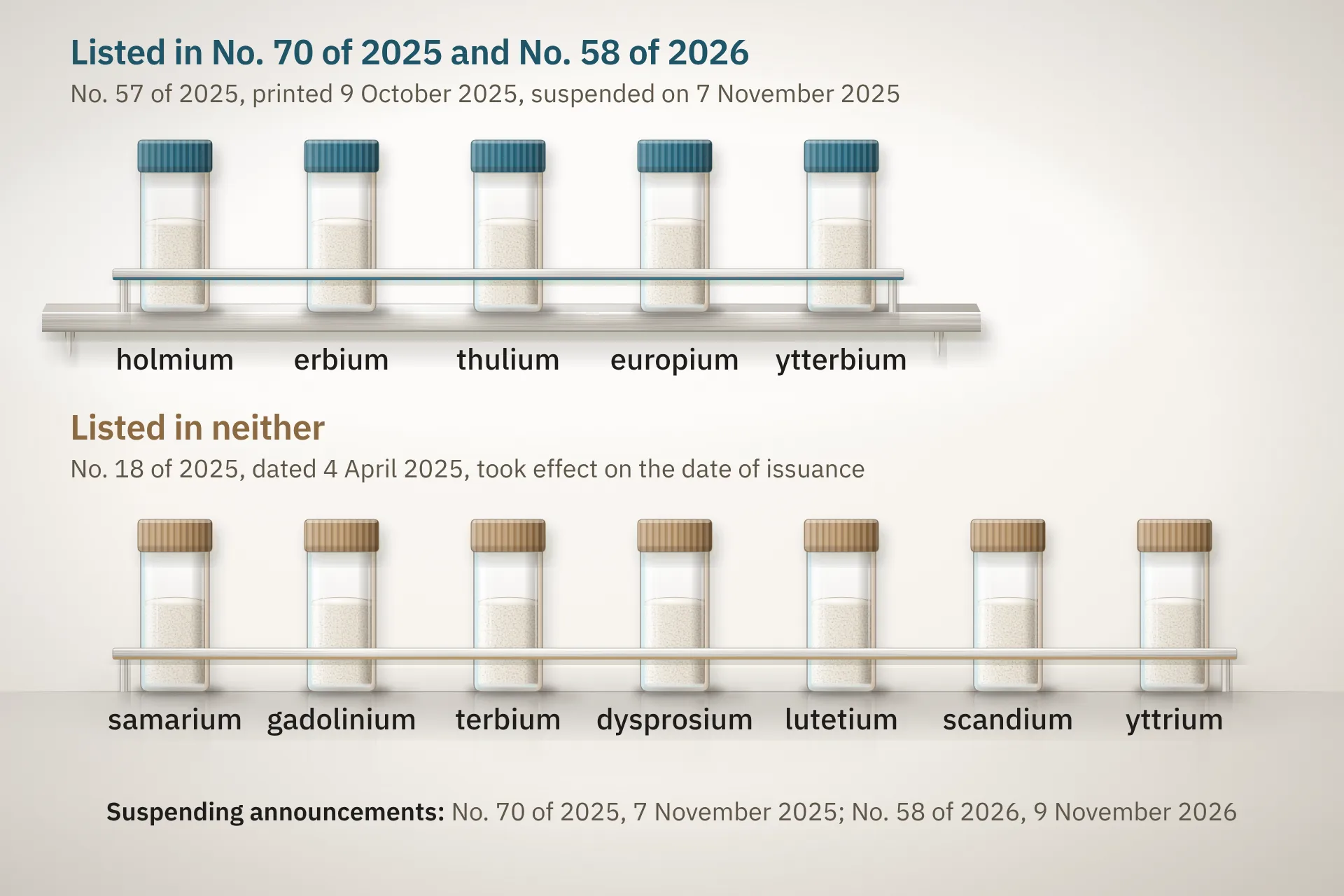
MOFCOM and GACC Announcement No. 18 of 2025, dated 4 April 2025, placed export controls on samarium, gadolinium, terbium, dysprosium, lutetium, scandium and yttrium related items. No. 18 covers each element's metal, alloys and related products, its oxides and mixtures, and its compounds and mixtures, and its permanent-magnet entries, for samarium, terbium and dysprosium, include magnets or magnetic powders. Under No. 18 of 4 April 2025, exporters must apply for a licence from the State Council commerce authority, and the announcement took effect on the date of issuance.
Announcement No. 70 does not list No. 18. Announcement No. 58 of 2026, which continued the suspension, does not list No. 18 either.
The US account, and a second Chinese suspension
The White House stated on 1 November 2025 that China would suspend the global implementation of the rare-earth export controls and related measures it announced on 9 October 2025. The White House's fact sheet of 1 November 2025 also stated that China would issue general licences valid for exports of rare earths, gallium, germanium, antimony and graphite for the benefit of US end users and their suppliers around the world. On the US side, the White House stated that the United States would suspend for one year, starting on 10 November 2025, the implementation of the interim final rule "Expansion of End-User Controls to Cover Affiliates of Certain Listed Entities".
A White House fact sheet of 17 May 2026 stated that China would address US concerns about supply-chain shortages of rare earths and other critical minerals, including yttrium, scandium, neodymium and indium. Two of the four elements that fact sheet names, yttrium and scandium, are among the seven named in Announcement No. 18.
A separate Chinese instrument followed two days after No. 70. MOFCOM Announcement No. 72 of 2025, dated 9 November 2025, suspended clause 2 of MOFCOM Announcement No. 46 of 2024, on export controls on certain dual-use items to the United States, until 27 November 2026. No. 72 does not suspend clause 1 of No. 46, which bans exports of dual-use items to US military users or uses.
Where each instrument stands
As of 20 November 2026, the six announcements remain suspended under MOFCOM and GACC Announcement No. 58 of 2026, dated 9 November 2026, which continued their suspension from 11 November 2026 until 10 January 2027. No. 70's own suspension period ran until 10 November 2026. No. 72's suspension of clause 2 of No. 46, dated 9 November 2025, ran until 27 November 2026. MOFCOM Announcement No. 59 of 2026, dated 24 November 2026, continues the suspension of clause 2 of No. 46 from 28 November 2026 until 27 January 2027. The US Bureau of Industry and Security's suspension of the Affiliates Rule took effect on 10 November 2025, and on 9 November 2026 BIS extended it, staying the rule's amendments until 10 January 2027.
Related
- Trade Agreements — the US–China understanding behind the November 2025 pause
- National Security — why export controls single out military end users
- Global Trade — how licences change what leaves China
- Supply Chain Risk — what a pause, rather than a repeal, leaves open
- Processing Capacity — the separation and magnet technology the controls reach
Sources
- PRIMARYMOFCOM and GACC, Announcement No. 70 of 2025, '公布暂停实施商务部、海关总署公告2025年第55号、56号、57号、58号及商务部公告2025年第61号、62号的决定', printed date 7 November 2025 (read as the Hong Kong Trade and Industry Department copy, https://www.tid.gov.hk/en/tradecircular/files/2025/ci9772025a.pdf). PDF p. 1: suspension of Nos. 55, 56, 57, 58, 61 and 62 of 2025 from the date of the announcement until 10 November 2026.
- PRIMARYMOFCOM and GACC, Announcement No. 58 of 2026, '公布继续暂停实施商务部、海关总署公告2025年第55号、56号、57号、58号及商务部公告2025年第61号、62号的决定', dated 9 November 2026. Suspension of Nos. 55, 56, 57, 58, 61 and 62 of 2025 continued from 11 November 2026 until 10 January 2027.
- PRIMARYMOFCOM and GACC, Announcement No. 55 of 2025, '公布对超硬材料相关物项实施出口管制的决定', 9 October 2025 (read as the Hong Kong Trade and Industry Department copy, https://www.tid.gov.hk/en/tradecircular/files/2025/ci8922025a.pdf). PDF p. 1: export controls on superhard-material-related items; effective date 8 November 2025.
- PRIMARYMOFCOM and GACC, Announcement No. 56 of 2025, '公布对部分稀土设备和原辅料相关物项实施出口管制的决定', 9 October 2025 (read as the Hong Kong Trade and Industry Department copy, https://www.tid.gov.hk/en/tradecircular/files/2025/ci8932025a.pdf). PDF pp. 1–4: items 2B902 (rare-earth production and processing equipment) and 1C914 (ores, flotation reagents, extractants); effective date 8 November 2025.
- PRIMARYMOFCOM and GACC, Announcement No. 57 of 2025, '公布对部分中重稀土相关物项实施出口管制的决定', 9 October 2025 (read as the Hong Kong Trade and Industry Department copy, https://www.tid.gov.hk/en/tradecircular/files/2025/ci8942025a.pdf). PDF pp. 1–3: holmium, erbium, thulium, europium and ytterbium related items, control codes 1C909 to 1C913; effective date 8 November 2025.
- PRIMARYMOFCOM and GACC, Announcement No. 58 of 2025, '公布对锂电池和人造石墨负极材料相关物项实施出口管制的决定', 9 October 2025 (read as the Hong Kong Trade and Industry Department copy, https://www.tid.gov.hk/en/tradecircular/files/2025/ci9022025a.pdf, and the MOFCOM page). Lithium-battery, cathode-material and graphite anode-material related items; effective date 8 November 2025.
- PRIMARYMOFCOM, Announcement No. 61 of 2025, '公布对境外相关稀土物项实施出口管制的决定', 9 October 2025 (read as the Hong Kong Trade and Industry Department copy, https://www.tid.gov.hk/en/tradecircular/files/2025/ci8892025a.pdf). Art. 1: licence for foreign-made listed items at a 0.1%-of-value threshold; Art. 2: applications not licensed in principle; Art. 4: case-by-case review; Art. 8: application dates.
- PRIMARYMOFCOM, Announcement No. 62 of 2025 (商务部公告2025年第62号), '公布对稀土相关技术实施出口管制的决定', 9 October 2025 (read as captured from mofcom.gov.cn, and as the Xinhua reprint). Control codes 1E902.a and 1E902.b; licence requirement for non-controlled exports known to be used for overseas rare-earth activities; effective on publication.
- PRIMARYMOFCOM and GACC, Announcement No. 18 of 2025, 'Announcing the decision to implement export control on some medium and heavy rare earth related items', 4 April 2025, MOFCOM's official English page, which states that the announcement is authentic in Chinese and the English version is for reference only.
- PRIMARYMOFCOM and GACC, Announcement No. 18 of 2025 (商务部 海关总署公告2025年第18号), 4 April 2025, Chinese text (read as the Hong Kong Trade and Industry Department copy, https://www.tid.gov.hk/en/tradecircular/files/2025/ci2025318a.pdf). pp. 1–4: controlled items, licence requirement, effective on publication.
- PRIMARYMOFCOM, Announcement No. 72 of 2025, '公布调整实施商务部公告2024年第46号的决定', 9 November 2025 (read as the Hong Kong Trade and Industry Department copy, https://www.tid.gov.hk/en/tradecircular/files/2025/ci9782025a.pdf). PDF p. 1: clause 2 of Announcement No. 46 of 2024 suspended until 27 November 2026.
- PRIMARYMOFCOM, Announcement No. 59 of 2026 (商务部公告2026年第59号), '公布继续调整实施商务部公告2024年第46号的决定', dated 24 November 2026, signed 23 November 2026 (read as captured from mofcom.gov.cn). Clause 2 of Announcement No. 46 of 2024 suspended from 28 November 2026 until 27 January 2027.
- PRIMARYMOFCOM, Announcement No. 46 of 2024 (关于加强相关两用物项对美国出口管制的公告), 3 December 2024. Clause 1: dual-use items to US military users or uses; clause 2: gallium, germanium, antimony, superhard materials and graphite dual-use items to the United States.
- PRIMARYThe White House, 'Fact Sheet: President Donald J. Trump Strikes Deal on Economic and Trade Relations with China', 1 November 2025. pp. 1–2: China's suspension of the 9 October 2025 measures and general licences, as the US government's account; US one-year suspensions of the Affiliates Rule and of Section 301 responsive actions.
- PRIMARYUS Department of Commerce, Bureau of Industry and Security, 'One Year Suspension of Expansion of End-User Controls for Affiliates of Certain Listed Entities', final rule, 90 FR 50857 (FR Doc. 2025-19846), November 2025. SUMMARY and DATES.
- PRIMARYUS Department of Commerce, Bureau of Industry and Security, 'Extension of the Suspension of Expansion of End-User Controls for Affiliates of Certain Listed Entities', final rule, 91 FR 70789 (FR Doc. 2026-22793), 9 November 2026. SUMMARY and DATES.
- PRIMARYThe White House, 'Fact Sheet: President Donald J. Trump Secures Historic Deals with China, Delivering for American Workers, Farmers, and Industry', 17 May 2026. p. 1: rare earths and other critical minerals; rare-earth production and processing equipment and technologies.
- ANALYSISANALYSIS: the reading, from the printed and effective dates of the texts, that Announcements Nos. 55 to 58 were suspended the day before they were due to take effect, that part 1(3) of No. 61 and the whole of No. 62 applied from 9 October 2025 until 7 November 2025, and that parts 1(1) and 1(2) of No. 61 had not taken effect as of 20 November 2026.Non-public document · no public URL