Minerals Hub / Innovation & Technology / Sorting ore rock by rock before it reaches the mill
Innovation & Technology · 6 min read
Sorting ore rock by rock before it reaches the mill
Sensor-based sorting looks at coarse ore one particle at a time and ejects the waste before fine grinding; this piece follows what the sensors detect, the size window they work in, and how strong the published evidence for the savings is.
Reviewed by Peter Uppal
The short version
Before ore is ground fine, a sensor-based particle sorter can examine coarse particles one at a time and reject those it reads as waste, while bulk sorters, by contrast, sort parcels of material on a conveyor; on high-capacity machines, compressed-air ejection has been the industry standard (as of 2019). A 2022 review says early removal of material that cannot be processed economically avoids unnecessary grinding and flotation, and that earlier studies show sorting can reduce energy, water and reagent use; that review and a 2019 review by Robben and Wotruba both treat energy savings qualitatively, without a quantified figure of their own. The method depends on ore that varies from rock to rock, works within a limited size window, and practically never recovers all of the valuable material.
A sensor and a puff of air
A 2019 review in Minerals by Robben and Wotruba defines the field broadly. Sensor-based sorting, in their account, is an umbrella term for applications in which particles are singularly detected by a sensor technique and then rejected by a mechanical, hydraulic or pneumatic action. On the ejection side the technology has settled: compressed-air ejectors with pneumatic valves have been the industry standard on high-capacity sorting machines for about three decades, the review said in 2019, while mechanical ejectors are installed in low-throughput units.
There are two ways to apply the idea. A 2022 review by Peukert, Xu and Dowd sets them out: in particle sorting, individual particles are sensed and characterised as either valuable or waste, while in bulk sorting parcels of bulk material on a conveyor belt are sorted instead of individual particles.
The method is not new. Robben and Wotruba record that the first patent on diamond sorting was registered in 1928, and X-ray luminescence machines have been systematically applied since the 1960s.
What the sensors see
The sensor decides what the sorter can tell apart. In X-ray transmission, or XRT, the 2022 review explains that the chance of a photon interacting with the material depends on its thickness, its density and its effective atomic number, a single average atomic number for a mixture of elements; using two X-ray energies makes it possible to correct for unknown thickness. The 2019 review describes the result as a planar projection of the attenuation.
Other sensors read different things. X-ray fluorescence signals come primarily from the surface of the material, as do optical signals; prompt gamma neutron activation analysis (PGNAA) samples the entire bulk volume and, the 2022 review says, is not suitable for particle sorting. The 2019 review describes near-infrared as a vibrational spectrometric method and laser sorting as detecting the reflection and diffraction of multi-channel laser light from the particles' surfaces. Luo and co-authors (2022) list colour, X-ray transmission, dual-energy X-ray transmission, X-ray fluorescence and near-infrared sorters, and names laser-induced breakdown spectroscopy and neutron activation among techniques expected to develop.
A window of sizes
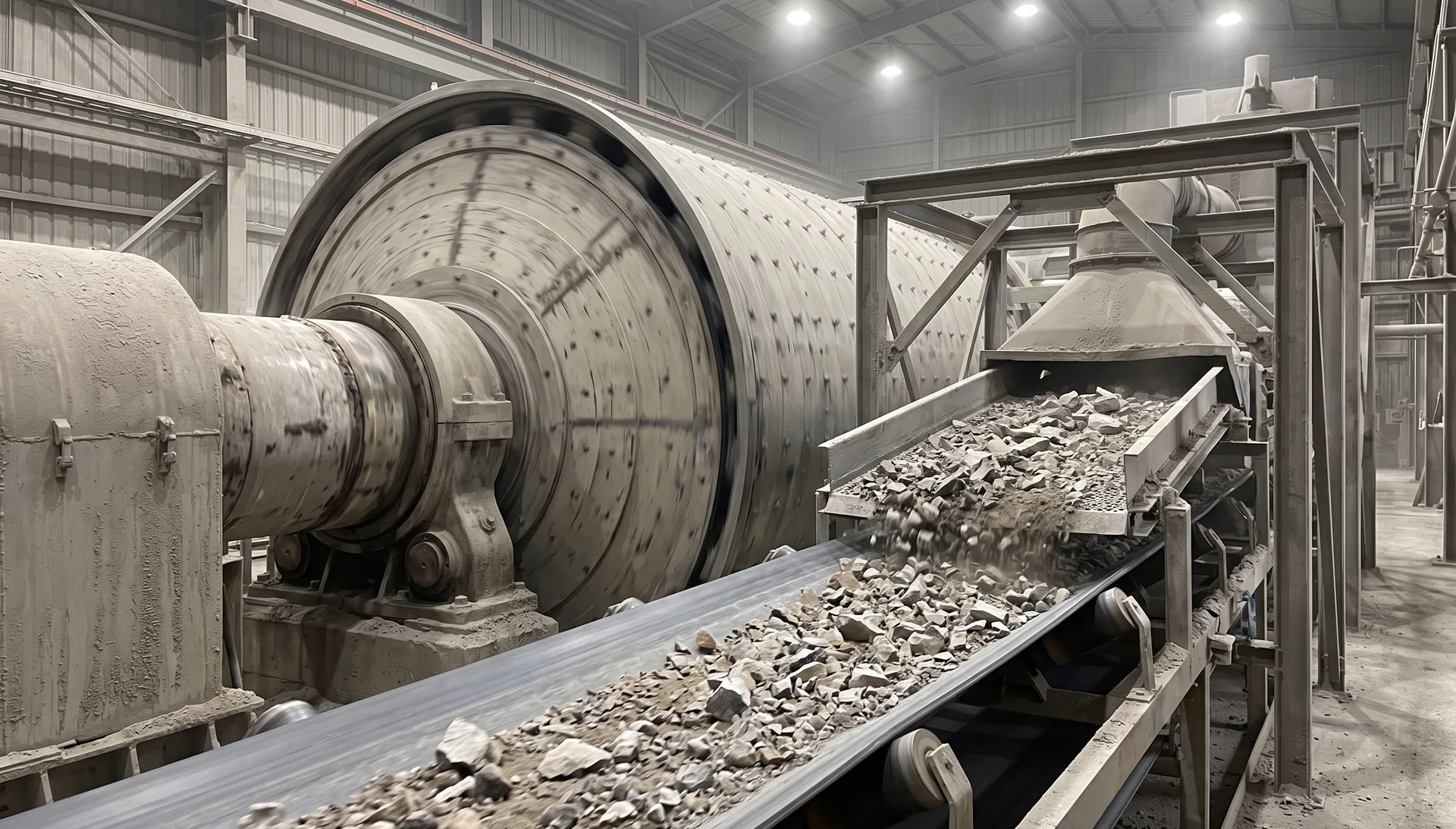
Robben and Wotruba describe sorting as a separation process for coarser grain sizes before the application of fine comminution, that is, fine crushing and grinding. Both ends of the window are bounded. For X-ray transmission sorting, the upper size is about 75 mm for ferrous-metal ores and up to 150 mm for coal or diamonds, set by how far the X-rays penetrate. At the bottom, the lower size limit is usually an economic barrier where sorting of fines becomes unfeasible.
Within the window, each particle sorter typically wants a narrow band. Peukert and co-authors write that a maximum size ratio of approximately 3 between smallest and largest particle is generally recommended, so the processed material must be separated by size into several streams. The cases in the 2019 review show what that means in practice: reported feed size ranges include 12–45 mm in one crushing case study, 4–125 mm at Botswana's Karowe diamond mine and 6–70 mm at the San Rafael tin mine. Every size range reported here is measured in millimetres.
The case for discarding rock early
The argument is about what the mill no longer has to grind. The 2022 review states that removing early the mined material that cannot be processed economically avoids unnecessary grinding and flotation, and links its benefits especially to low grade heterogeneous ores which contain high quantities of gangue, the worthless minerals in an ore. The 2019 review gives the mechanism: discarding more waste raises the grade of values fed to the downstream processes.
One site in the 2019 review puts a figure on it. At Austria's Mittersill tungsten mine, sorting rejects about a quarter of run-of-mine ore (ore as it comes from the mine) as coarse waste, which the review says raises mill feed grade by about 25%.
The waste also leaves in a different state. Coarse sorter rejects over 10 mm usually hold about 5% moisture by weight, against about 70% for mill tailings around 100 µm, the review says, citing earlier work.
On energy, the reviews are qualitative. The 2022 review says previous studies show that sensor-based sorting can reduce energy, water and reagent consumption.
"The sensor-based ore-sorting step practically never reaches 100% recovery." (Robben and Wotruba, 2019)
How strong the evidence is
Feasibility turns mainly on the ore. Robben and Wotruba write that feasibility depends mainly on the type of mineralisation, because sorting exploits heterogeneity at relatively large particle sizes.
The 2022 review gathers reported results by sensor, and they spread wide. The studies it reviewed showed XRT particle sorting can typically recover 90%+ of the desired product in 20%–70% of the mass, and the optical-sorting studies it describes 70%–90% in 25%–50%, and the review stresses that sorting is highly ore dependent. It is sceptical of some modelled gains: one study's profit figure is likely an overestimate, using particle sorting results with bulk sorting costs. Single-site evidence is narrow by design. A 2021 trial on one stope (a single underground mining block) at Brazil's Córrego do Sítio gold mine combined X-ray transmission and laser sorting; the authors judged it feasible only for a very specific stope application.
The record is also incomplete. The 2022 review notes that, because of commercial confidence, many implementations and investigations of sorting may not be published. In 2019 Robben and Wotruba judged that, outside industrial minerals and diamond processing, sorting could still be considered at market-entry stage for the minerals industry.
Recovery has a cost that does not show in a grade figure. The 2019 review says sorting practically never reaches 100% recovery, and the shortfall has to be costed as lost production. And plants have failed for other reasons: the review names misunderstanding of fundamental sampling principles, and failing to call on an engineer for calibration, as the primary reasons for sorting-plant failures and shutdowns.
Related
- New Processing Technologies
- Ore Processing
- Processing Innovation
- Environmental Management
- Water
Sources
- PRIMARYRobben, C. and Wotruba, H., 'Sensor-Based Ore Sorting Technology in Mining: Past, Present and Future', Minerals 9(9), 523, 2019, doi:10.3390/min9090523. Peer-reviewed review. s 2.2 (diamond sorting history); s 2.3 (market stage); s 3 (definition; ejectors); s 4 (heterogeneity); s 4.1 (grade and recovery); s 4.3 (moisture of rejects and tailings); s 6.1 (XRT imaging; causes of plant failures); s 6.2 (size limits); s 8 (crushing case study); s 9 (Mittersill, Karowe, San Rafael).
- PRIMARYPeukert, D., Xu, C. and Dowd, P., 'A Review of Sensor-Based Sorting in Mineral Processing: The Potential Benefits of Sensor Fusion', Minerals 12(11), 1364, 2022, doi:10.3390/min12111364. Peer-reviewed review. s 1 (particle and bulk sorting; size ratio; early waste removal; earlier studies on energy, water and reagents); p. 4 (unpublished implementations); Table 2 (modelled profit gains); s 2.2 (sensor types and the studies' reported results).
- PRIMARYAssis, V. M., Henriques, A. B., Lemos, M. G. and Dumont, J. A., 'Technological innovation in Córrego do Sítio Mineração: A study of technical and economic aspects by using sensor-based sorting for refractory gold ore', REM International Engineering Journal 74(1), 117–125, 2021, doi:10.1590/0370-44672020740097. Peer-reviewed case study of a single-stope trial; used here for its qualitative conclusion only.
- SECONDARYLuo, X., He, K., Zhang, Y., He, P. and Zhang, Y., 'A review of intelligent ore sorting technology and equipment development', International Journal of Minerals, Metallurgy and Materials 29(9), 1647–1655, 2022, doi:10.1007/s12613-022-2477-5. Abstract only: sorter types in use and techniques expected to develop.